
Review · ROME
Rome’s Dark Side Ghosts and Legends Tour
Rome’s prettiest streets take on a different mood after sunset. This two-hour walk leads you from Campo de’ Fiori to Castel Sant’Angelo through tales of poisoners, prisoners, executioners, haunted bridges, and a magician said to still linger in a narrow lane. The history is unusual, and the stories give familiar sights a sharper edge.
I like the small group of up to 15 and the way the tour reaches places a standard Rome highlights walk may pass without stopping. I also like the timing: cooler streets, fewer crowds, and a chance to see the historic center at night. The main drawback is physical, not spooky: you will walk and stand on cobblestones, so comfortable shoes are essential.
Key points to know before booking
- Nine stops in two hours: The route runs from Campo de’ Fiori through central Rome to Castel Sant’Angelo.
- A storytelling-led tour: Guides including Ben, Ivana, Ariel, and Alethea combine documented history, local legends, and dark humor.
- Small groups matter: The maximum group size is 15, which makes it easier to hear stories in narrow streets.
- A gelato stop with a sinister past: One stop takes you to a modern gelato shop that once had a very different role.
- Night brings practical benefits: The evening start helps with summer heat and crowded daytime streets.
- Prepare for uneven ground: The route includes cobbled lanes and plenty of standing, even though most people can take part.
Why Rome’s dark stories work so well at night
Rome is full of grand monuments, but its history is also crowded with crime, power struggles, religious scandals, public punishment, and people whose reputations refused to die. This tour uses that less polished side of the city as its main subject.
You are not spending two hours inside a museum or waiting in line for a famous monument. Instead, you move through streets and piazzas while a guide connects the buildings around you with people and events that often get left out of a standard sightseeing route.
The supernatural element is part of the fun, but this is not presented as a horror attraction. Several guides, including Ben, Ivana, Ariel, and Alethea, are praised for making the material entertaining without losing the historical setting. Expect a mix of documented figures, local legends, dark humor, and stories designed to make you look twice at an otherwise ordinary doorway.
The experience is best for you if you enjoy history with a dramatic twist. If you want jump scares, theatrical costumes, or a formal ghost-hunting experience, this may feel too gentle. One useful description from the tour itself is entertainment and chills, with the emphasis likely falling more on storytelling than fright.
More Dark History Tours in Italy
- Venice: Mysterious Tales of Ghosts and Murders
★ 4.9 · 636 reviews - Rome: Guided Bar Crawl with Drinks & Dark History
★ 4.9 · 444 reviews - Rome: Small Group Rome’s Dark Side – Ghosts & Legends Tour
★ 4.9 · 343 reviews
Campo de’ Fiori begins with a warning
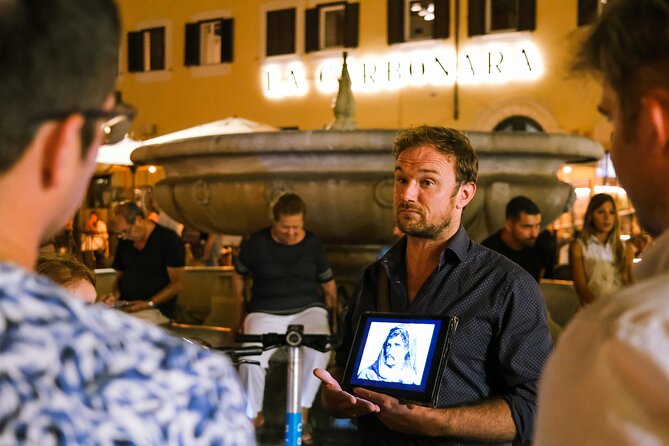
The meeting point is Campo de’ Fiori, and the guide begins with the first story here at 8 pm. This is a sensible place to start because the square already has a complicated personality. In daylight, it is one of central Rome’s familiar public spaces. After dark, the same setting can feel more secretive, especially when the guide frames it through the city’s darker past.
Allow a little time to find the guide before the start. The tour begins promptly at 8 pm, and Campo de’ Fiori can be lively. You will not pay an entrance fee at any stop because the route takes place outdoors in public streets and squares.
From here, the walk heads toward Piazza Farnese. The distance between stops is part of the experience, not wasted time. The guide continues the story while you move through the historic center, and the city itself becomes the backdrop.
Piazza Farnese and the stories behind grand buildings
Piazza Farnese brings you to a Renaissance palace and the buildings around it. The appeal here is the contrast between Rome’s polished public face and the less comfortable stories beneath it.
You will hear details that do not usually appear on a basic sightseeing walk. That is one of the strongest reasons to choose this tour after you have already seen the major monuments. The guide can point out how a place known for architecture and power also connects to rumor, ambition, and darker episodes.
The stop lasts about 10 minutes, so expect a focused story rather than a long architectural lecture. That keeps the pace moving, although anyone hoping for a detailed art-history talk may want a separate tour of Rome’s Renaissance sites.
A magician in Vicolo delle Grotte
The route then turns into Vicolo delle Grotte, one of the narrow backstreets that give central Rome its character. Here you hear about an 18th-century magician who is said to haunt the area.
This is the kind of stop that makes the tour different from a regular history walk. You are not simply being told that an old building is important. You are asked to consider how stories cling to a particular lane, how reputation grows, and why a figure from centuries ago remains part of the local imagination.
The narrow setting helps the atmosphere, but it also means you may need to stand close to the group to hear clearly. That is another reason the 15-person limit is useful.
More Dark History Tours in Rome
- Rome Secrets: Dark History & Tasty Bites Tour
★ 5.0 · 37 reviews
Ponte Sisto and the woman who ruled Rome
At Ponte Sisto, the subject changes to a woman who rose to power and, according to legend, still haunts the bridge. The stop lasts about 15 minutes, giving the guide more time to explain her rise and the reason her name remains linked to this crossing.
This part should appeal to anyone who likes political history told through individual lives. Rather than treating Rome as a collection of emperors and monuments, the story focuses on a powerful woman and the ways her memory survived.
The bridge also gives the walk a change of scenery. You move out of the tighter lanes and onto a major crossing, with the evening city around you. You may find this one of the more atmospheric points on the route, though the tour does not promise a supernatural sighting.
Via Giulia and the monks with a grim task
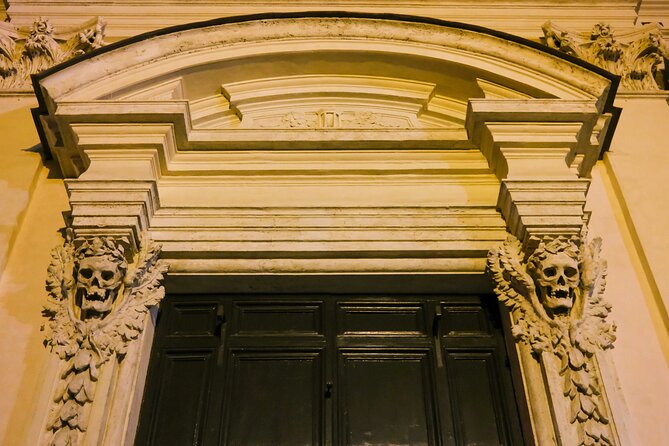
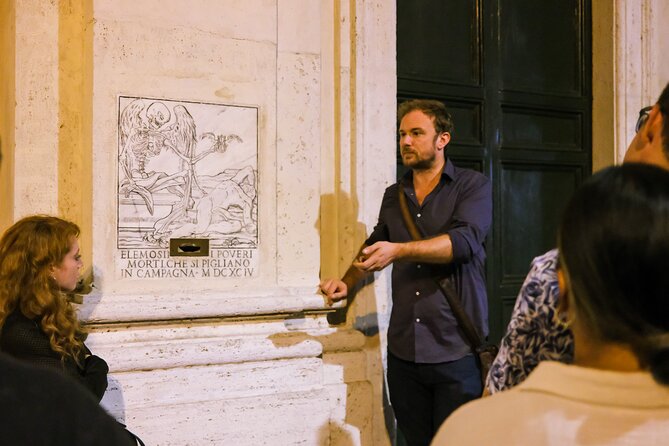
Via Giulia brings another change in tone. Here, the guide tells the story of a mysterious order of monks assigned a macabre task.
The value of this stop is the way it connects religious life with death and ritual. Rome’s churches and religious buildings can look calm and orderly, but their histories often include work that was anything but peaceful. The guide uses the street as a starting point for that story.
You will be standing for about 15 minutes, then walking onward. If you have already spent the day inside the Colosseum, Roman Forum, or Vatican Museums, this is when tired legs may begin to matter. One person who had spent three and a half hours touring Ancient Rome in the sun found an evening walk too much. Plan your day with that in mind.
Via di Monserrato and a notorious pope
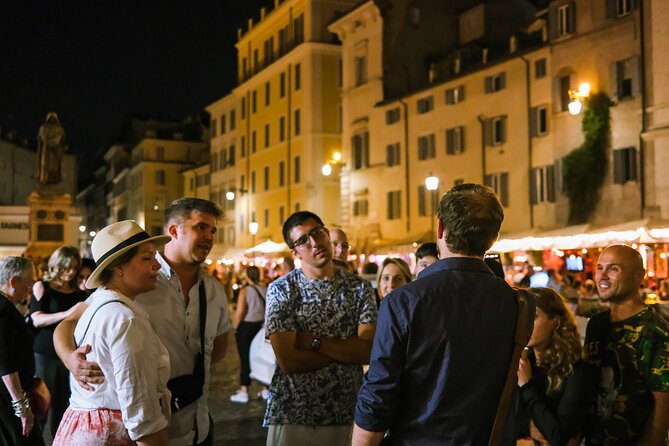
Via di Monserrato is one of the longer stops, again about 15 minutes. The subject is a notorious pope, his family, a feared prison, and the idea that his presence still haunts the area.
This is not a polished portrait of religious history. The story looks at power, family influence, punishment, and the darker side of papal Rome. It also shows why a ghost tour can be useful even when you do not take the supernatural claims literally. The legends preserve memories of real people and real fear.
The prison connection adds weight to the stop. You are not hearing only about palace intrigue. You are also hearing about confinement and punishment in a city where religious authority and civic power were closely linked.
Via dei Banchi Vecchi and the gelato surprise
One of the tour’s most unusual details comes on Via dei Banchi Vecchi. A modern gelato shop occupies a place that was once connected with one of history’s most prolific poisoners.
A break stop at a cafe is offered during the tour, but food and drinks are not included. The gelato shop is therefore best understood as a chance to look at the location and perhaps buy something for yourself, rather than as part of the admission price.
I like this stop because it connects ordinary modern life with Rome’s unsettling past. You might be buying gelato while standing in a place with a very different former reputation. That contrast is exactly the sort of small detail you are unlikely to get from a standard monument-focused walk.
The executioner’s house on Via del Banco di Santo Spirito
On Via del Banco di Santo Spirito, the guide points out the house of Rome’s most famous executioner. The stop lasts about 15 minutes, allowing time for the guide to explain the person’s role and reputation.
This story brings the city’s justice system into view. Executioners are often treated as shadowy figures in the background, but Rome gave them a place, a profession, and a public identity. Learning where one lived makes the past feel less abstract.
The subject is grim, but the guide’s style matters here. Ben is known for a witty, entertaining approach, while Ivana has been praised for bringing personal warmth and humor to difficult material. The presentation keeps the evening from becoming bleak.
Castel Sant’Angelo ends with tragedy
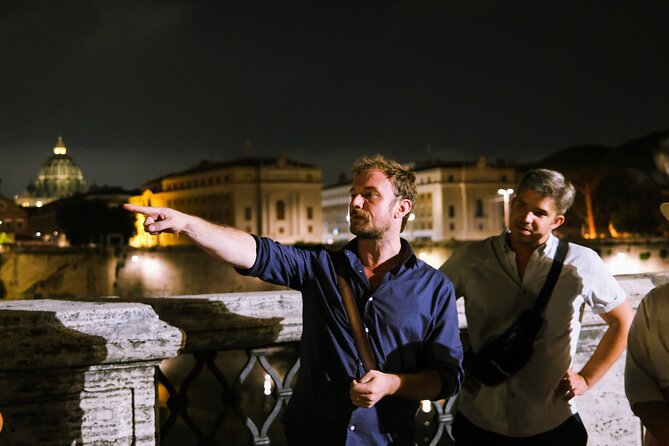
The walk finishes at Castel Sant’Angelo, with the group ending by St. Angelo Bridge. The guide explains how the building began as an emperor’s tomb and later became associated with imprisonment and executions.
This final stop gives the tour a strong historical arc. You begin among public squares and narrow lanes, then finish beside one of Rome’s most recognizable fortified monuments. The castle’s changing roles reflect the city’s own history: imperial power, religion, military control, confinement, and punishment.
The last story is one of the tour’s most tragic. It is a fitting ending because Castel Sant’Angelo is visually impressive even without the legend, but the tale changes how you see its walls and bridge.
The guide can give directions from here to wherever you need to go. That is useful if you are unfamiliar with the area, though you should still have your own transport plan if you need to reach a distant part of Rome.
How much walking and standing should you expect?
The advertised duration is about two hours, but the physical effort depends on your pace and how much walking you have already done. The route includes Campo de’ Fiori, Piazza Farnese, Vicolo delle Grotte, Ponte Sisto, Via Giulia, Via di Monserrato, Via dei Banchi Vecchi, Via del Banco di Santo Spirito, and Castel Sant’Angelo.
Each stop lasts roughly 10 to 15 minutes, with additional walking between them. You should expect to stand while listening and cross uneven cobbled streets. Wear shoes with good support, and avoid scheduling this immediately after a full day of intense sightseeing if you are not used to long walks.
Most people can participate, and service animals are allowed. Sign language interpreters can often be arranged if requested in advance. Still, do not assume that a general accessibility description means a smooth, easy route. Cobblestones made the walk difficult for at least one couple, so ask for specific guidance before booking if mobility is a concern.
Is the $24.19 price a good value?
At $24.19 per person, this is a reasonably priced way to spend an evening in central Rome. You are paying for an English-speaking guide, a small group, and a carefully connected route through several historic neighborhoods. There are no separate admission charges at the stops.
The value comes from the storytelling rather than from entry to a monument. You are not paying for access to Castel Sant’Angelo or a private room inside a palace. If you want a guided look at Rome’s darker characters and lesser-known stories, the price is modest.
The small group also helps. A maximum of 15 people is large enough to create a social feel but small enough for a guide to hold your attention in narrow streets. It is not a private tour, so you should expect some group pacing and standing.
Who should book this evening walk?
I would choose this tour for a first or second evening in Rome if you want an easy way to see the city from a different angle. It can also work well on your last night, when you want something social and atmospheric without another major museum visit.
It suits you if you enjoy:
- Roman history told through memorable characters
- Legends mixed with real places and documented events
- Walking through central Rome after dark
- Small groups and lively guides
- Dark humor without a full horror-show format
I would be cautious if you dislike uneven streets, standing, or stories about executions, poison, prisons, and grim religious history. Families with young children should also consider the subject matter before booking.
The tour is offered in English only, and confirmation is provided at booking. Free cancellation is available until 24 hours before the start time. Changes or cancellations made inside that window are not accepted for a refund.
Should you book Rome’s Dark Side Ghosts and Legends Tour?
Book it if you want Rome to feel less like a checklist of monuments and more like a city shaped by strange lives, bad decisions, power, and rumor. The guides bring clear energy to the walk, with Ben, Ivana, Ariel, and Alethea among the names associated with the experience.
The strongest reasons to go are the small group, the evening setting, the unusual route, and the mix of serious history with dry humor. The main tradeoff is the cobblestone walking and the fact that the tour is more fascinating than frightening.
For about $24, it is a good-value introduction to Rome’s darker side. Put on comfortable shoes, leave room in your schedule, and do not arrive exhausted from a day in the Forum. The ghosts may be imaginary, but your tired feet will be real.
FAQ
Where does the tour start?
The tour starts at Campo de’ Fiori in Rome.
What time does the tour begin?
The start time is 8 pm.
Where does the tour end?
The tour ends by Castel Sant’Angelo at St. Angelo Bridge, also called Ponte Sant’Angelo.
How long is the tour?
The walking tour lasts approximately two hours.
What language is the tour offered in?
The tour is offered in English.
How large is the group?
The maximum group size is 15 people.
Are food and drinks included?
No. Food and drinks are not included, although a break stop at a cafe is offered. Gratuities are also optional and not included.
Can service animals join the tour?
Yes. Service animals are allowed.
Can I cancel for a full refund?
Yes. You can cancel at least 24 hours before the start time for a full refund. Cancellations or changes made less than 24 hours before the experience are not accepted for a refund.
More Ghost Story Tours in Italy
- Venice Ghost Stories, Legends and Anecdotes Tour
★ 4.0 · 846 reviews - Ghosts, Legends & Mysteries of Rome Tip-Based Walking Tour
★ 4.7 · 284 reviews - Venice: The Ghost & Legends Walking Tour
★ 4.0 · 206 reviews - Ghosts Legends and Mysteries of Rome Walking Tour
★ 5.0 · 149 reviews
Just added in Italy
- Venice: The Ghost & Legends Walking Tour★ 4.0 · 206 reviews
- Ghosts Legends and Mysteries of Rome Walking Tour★ 5.0 · 149 reviews
- Rome Secrets: Dark History & Tasty Bites Tour★ 5.0 · 37 reviews
- Tipsy Tour: Guided Bar Crawl In Florence with Dark History★ 5.0 · 271 reviews
- Ghosts, Legends & Mysteries of Rome Tip-Based Walking Tour★ 4.7 · 284 reviews
- Rome: Small Group Rome’s Dark Side – Ghosts & Legends Tour★ 4.9 · 343 reviews
- Rome: Guided Bar Crawl with Drinks & Dark History★ 4.9 · 444 reviews
- Haunted Rome Ghost Night Walking Tour★ 5.0 · 495 reviews
Ghost Stories & Local Legends, compared.

Ghost Walking Tour Where Legends Come To Life
Read our review →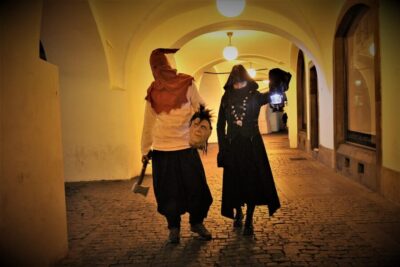
Ghosts, Legends, Medieval Underground & Dungeon Tour
Read our review →
Ghosts and Legends of the Old Town Evening Tour
Read our review →
Prague Ghost and Legend of Old Town Walking Tour
Read our review →
Ghosts and Legends Nighttime Guided Walking Tour
Read our review →
Gothic Quarter Ghosts and Legends Walking Tour
Read our review →
Buda Castle District Dark History, Legends and Vampire Night Tour
Read our review →Browse the lists this tour appears in