
Review · DETROIT
Macabre, Murder, & Mayhem in Motor City : Detroit Ghost Tour
Detroit’s haunted side is less about rattling doors and more about ghost stories attached to grand old buildings. This walking tour links the Alhambra Building, Masonic Temple, James Scott Mansion, Orchestra Hall, and other Detroit landmarks with tales of suicide, murder, lost patrons, musicians, and restless owners.
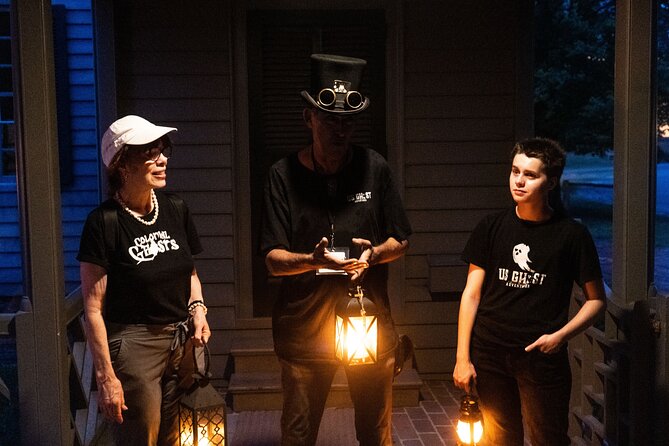
I like two things here: you get a quick look at several important Motor City buildings, and the best guides bring real affection for Detroit to the walk. Andrew has been praised for his enthusiasm, while Michael is noted for being kind, patient, and well prepared. The main catch is simple: you do not go inside the buildings, so this is part outdoor history walk and part ghost tour.
The $32 price is fair if you want an easy introduction to Midtown Detroit and enjoy spoken stories. It is less convincing if you expect paranormal tools, indoor access, theatrical scares, or a tightly staged one-hour production. The tour’s quality appears to depend heavily on the guide.
Key points to know before you book
- Eight landmarks in about an hour: The route moves from 100 Temple Street to Detroit Medical Center Central Campus, with roughly seven or eight minutes at each stop.
- Outdoor viewing only: You hear stories from the sidewalks and streets. No historic building entry is included.
- More history than horror: The strongest experience combines architecture, Detroit personalities, and grim tales rather than constant scares.
- A one-way route: You finish about a mile from the starting point, so plan how you will return to your car.
- Guide quality matters: Andrew and Michael have received especially warm praise, while other accounts describe uneven pacing and storytelling.
- Good for first-time Detroit visitors: The walk gives you a compact look at several notable places while adding a spooky theme.
What this Detroit ghost walk is really like
The title promises murder and mayhem, but the actual experience is a guided city walk with supernatural stories layered onto Detroit history. You gather at 100 Temple Street, near the Alhambra Building, then move through a series of landmarks before finishing at the Detroit Medical Center Central Campus.
The official length is about one hour. The listed stop times add up to almost that much, and the route covers about a mile according to one detailed account. Still, the walk may take longer depending on the guide, group pace, and time spent between locations. One account described a two-hour experience, so leave some flexibility in your evening.
The group can reach up to 35 people. That is large enough to create energy, but it can make questions and storytelling harder to follow. You will want to stay close to the guide, especially after dark and at busy street crossings.
More Dark History Tours in the USA
- Adults-Only New Orleans Ghost, Crime, Voodoo, and Vampire Tour
★ 5.0 · 6,545 reviews - New Orleans Adults-Only True Crime and Ghost Walking Tour
★ 5.0 · 1,666 reviews - Genteel and Bard’s Savannah Dark History and Ghost Encounter Walking Tour
★ 5.0 · 1,546 reviews
100 Temple Street and the Alhambra Building
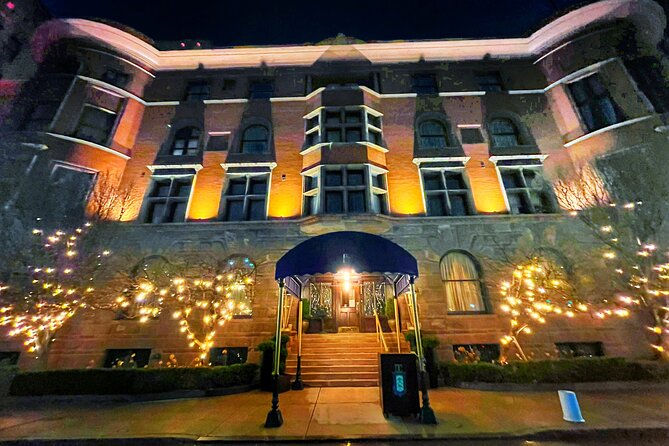
The Alhambra Building provides a fitting start. Its ghostly reputation centers on whispers said to echo through the building at night. Once a busy place, it now carries stories of unexplained sounds and spirits that supposedly never moved on.
You spend about eight minutes here, hearing the opening tale and getting oriented to the tone of the walk. The building works well as a first stop because it sets up the main pattern: look at the exterior, hear what happened there, then move on.
Do not expect to enter the Alhambra. The story comes from the street, which means the atmosphere depends on the guide’s delivery and the building’s appearance after dark. If you enjoy old facades and verbal storytelling, this can be a strong opening. If you need physical evidence or an indoor setting, it may feel thin.
Masonic Temple: grand architecture and a grim legend
The Masonic Temple is one of the route’s most imposing sights. Its scale and maze-like reputation give the guide plenty to work with, especially the stories about secret rooms and corridors.
The central legend concerns the building’s architect, who is said to have taken his own life inside its walls. His ghost is rumored to remain connected to the temple. The tale adds a darker edge to what might otherwise be a short architecture stop.
You will view the building from outside for roughly seven minutes. That matters here because the interior mystery is part of the appeal. Hearing about hidden rooms without seeing them can leave you wanting more, but the exterior alone gives the stop a strong visual anchor.
I would pay attention to the guide’s balance between fact and legend. The best version makes clear what belongs to Detroit history and what belongs to local ghost lore. That distinction helps you enjoy the story without treating every haunting claim as established fact.
James Scott Mansion and the trouble with a famous owner
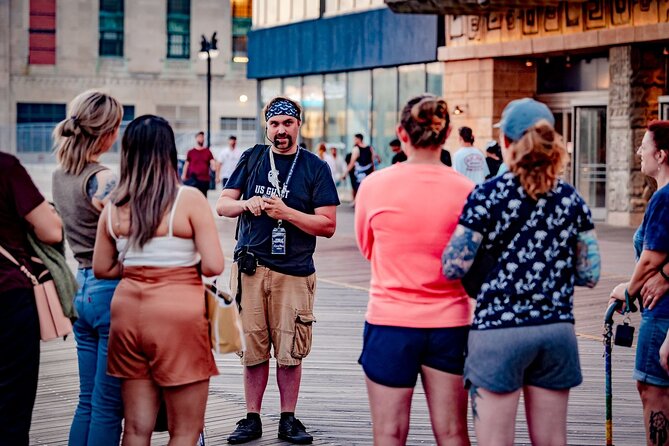
The James Scott Mansion shifts the focus from architecture to personality. The mansion is linked to James Scott, an eccentric millionaire whose reputation provides the emotional fuel for the ghost story.
Local lore says Scott’s vengeful spirit still wanders the property. His ghost is presented as spiteful and mischievous, a fitting afterlife for a man remembered through tales of grudges and trouble.
This stop lasts about eight minutes. You are not entering the decaying mansion, so the point is to see the exterior and connect it with the story. The neglected appearance can make the setting more atmospheric, but it also means you should not expect a restored house tour or close look at interior details.
For me, this is the kind of stop that explains why the experience works best as morbid history. The story is not just a ghost appeared here. It is about how a person’s reputation can cling to a place long after that person is gone.
Same streets, a very different kind of fright:
- New Orleans Premier Ghost, Voodoo and Vampire Walking Tour
★ 4.5 · 12,856 reviews - Chicago: Gangsters and Ghosts Walking Tour
★ 5.0 · 7,155 reviews - Salem’s Best Ghost Tour
★ 4.5 · 4,186 reviews - Haunted Evening Horse and Carriage Tour of Charleston
★ 4.5 · 3,678 reviews
Grey Ghost Detroit and Detroit’s Prohibition shadows

Grey Ghost Detroit brings in the Prohibition era. The former speakeasy is said to be haunted by the spirits of patrons who never left, giving the stop a different mood from the mansion and temple.
The name itself supports the theme. You are looking at a place associated with secrecy, hidden drinking, and people who had reasons to stay out of sight. The guide connects those old stories with reports of spectral former customers.
Again, you remain outdoors for about seven minutes. The value comes from the setting and the tale, not from touring a preserved speakeasy interior. If you hoped to see secret rooms or old bar details, adjust your expectations before booking.
This is one of the more appealing stops for anyone interested in Detroit’s social past. It adds a period story to the route and breaks up the pattern of haunted residences and public buildings.
Orchestra Hall and ghosts drawn to music
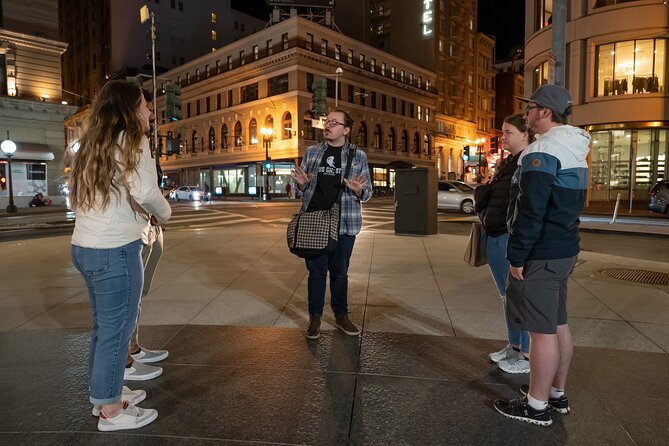
Orchestra Hall offers a quieter kind of haunting. The Detroit Symphony Orchestra Building is tied to reports of strange sounds and ghostly figures believed to be musicians from earlier eras.
The idea is easy to picture: performers who spent their lives around music still returning to the place where it once filled the halls. It is less bloody than some of the other stories, but it gives the walk a change of pace.
You spend about eight minutes here. Since you stay outside, you will not hear a concert or inspect the auditorium. The stop depends on the guide describing the sounds and apparitions well enough for you to imagine the interior.
This is a good example of the tour’s range. The route is not built only around murder. It also uses stories about work, performance, fame, and attachment to place. That makes the experience more suitable for history fans who like a spooky angle but do not want nonstop horror.
The Majestic Theatre and performers who never left
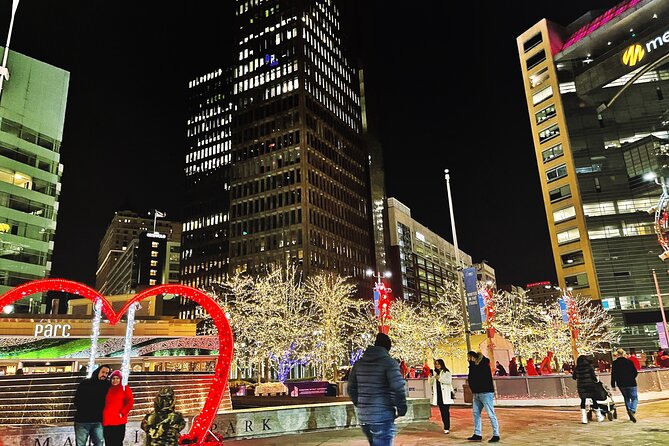
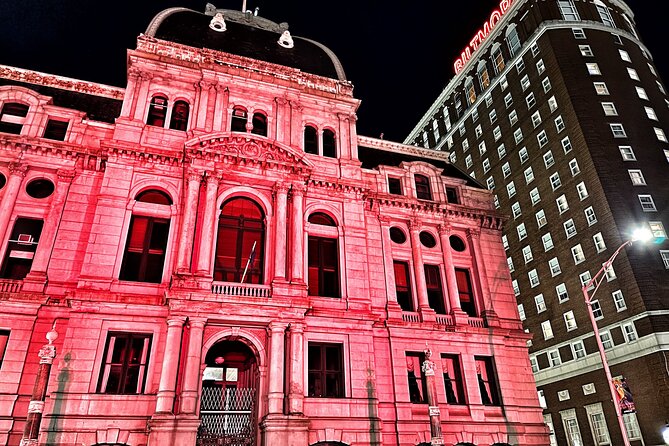
The Majestic Theatre adds another entertainment connection. Reports describe ghostly figures in the shadows, often linked to former performers and patrons.
The story suggests that some spirits are still repeating their final acts. It is a familiar theatrical idea, but the setting gives it a natural home. A theater already carries a sense of performance and illusion, so the ghost story fits without much effort.
The stop lasts around seven minutes. You should think of it as an exterior landmark talk rather than a theater visit. The lack of indoor access is especially important here because theaters usually offer their best atmosphere inside, with dark corridors, backstage spaces, and old seats. You will hear about that mood rather than experience it directly.
If your main interest is Detroit’s theater and music culture, this stop adds useful context. If your priority is a scare, it may depend almost entirely on the guide’s timing and voice.
The Whitney and David Whitney Jr.’s staircase
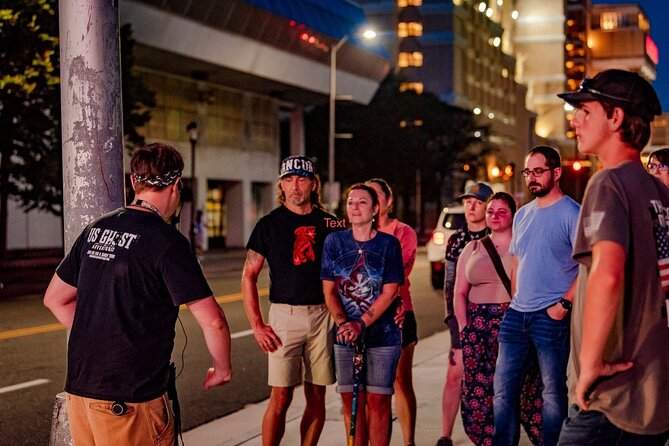
The Whitney is one of the route’s best-known haunted addresses. Once a private home, it is now associated with the ghost of original owner David Whitney Jr.
The most familiar story places a spectral figure on the grand staircase. That image gives the guide a clear visual detail to describe, and it connects the building’s formal design with the idea of a ghost still moving through the house.
You spend about eight minutes here. The building’s exterior can make a strong impression, but you do not tour the staircase or interior. That is worth knowing before you arrive, since the staircase is central to the haunting story.
The Whitney also helps the tour move beyond anonymous haunted buildings. The tale has a named owner, a specific part of the house, and a clear connection between the person and the place. Those details give the story more shape than a general report of strange activity.
Detroit Medical Center and the final stories
The walk ends at Detroit Medical Center Central Campus, at 4201 St. Antoine Street. The campus has an obvious connection to life, death, illness, and loss, so it provides a natural setting for the closing stories.
The guide discusses reported apparitions believed to be patients who never left. These stories can feel more unsettling than the earlier legends because hospitals are places where personal fear and grief are already close to the surface.
The guide shares a few final stories here before sending you on your way. This is not the same location as the start, so make a plan before the tour begins. If you parked at 100 Temple Street, you may need to walk back down Woodward Avenue for more than 20 minutes, use public transportation, or arrange another ride.
The one-way finish is the most practical drawback of the route. It lets the tour cover more ground, but it can be an unpleasant surprise if you expected to return to your vehicle at the starting point.
What the guide can make or break
The strongest praise centers on guides who combine Detroit knowledge with warmth and energy. Andrew has been singled out for enthusiasm and strong command of the subject. Michael has been described as kind, patient, and well informed, with stories that made the walk enjoyable.
A Detroit native guide has also been praised for sharing clear affection for the city and explaining its three-century story in a way that worked for both an adult and a child. That kind of local connection is exactly what can turn a string of exterior stops into a worthwhile introduction to Detroit.
The less successful versions have had problems with late starts, flat delivery, weak answers to questions, long gaps between locations, and stories that did not always connect closely to the building in view. One account also described the walk as moving too quickly.
This variation matters more here than it would on a self-guided audio walk. You are paying for the person telling the stories. If the guide is lively, the city streets become a stage. If the delivery is unprepared, you may feel as if you are simply walking past buildings while someone recites loose facts.
Price, timing, and comfort
At $32 per person, the tour sits in a reasonable range for a short guided city walk. The price makes sense if you value a local guide, a planned route, and a themed introduction to several Detroit landmarks.
The value drops if you expect paid entry, indoor tours, ghost-hunting equipment, or a theatrical performance. Admission to every stop is free because the sites are viewed from public streets.
The tour is offered in English and uses a mobile ticket. Service animals are allowed, the route is near public transportation, and most people can participate. Wear comfortable shoes and bring clothing suited to an evening outdoors. The supplied details do not promise seating, indoor shelter, or a slow pace.
Free cancellation is available up to 24 hours before the start time. Within 24 hours, refunds are not provided. Gratuity for the guide is not included, so bring that into your budget if the guide gives you a good evening.
Who should book this walk
I would recommend it to you if you like:
- Detroit architecture viewed from the street
- Local legends tied to real places
- Morbid history without a full horror-show format
- Short evening walks
- Meeting other people in a small city activity
- A quick introduction to Midtown landmarks
Families can enjoy it if children are comfortable with stories about death, ghosts, and suicide. The content is not presented as a children’s attraction, so use your judgment.
I would be cautious if you want indoor access, dramatic scares, paranormal equipment, or guaranteed one-hour timing. You should also think twice if you are driving and have not planned the return from the Detroit Medical Center.
Should you book the Detroit Ghost Tour?
Book it if you see the experience as a Detroit history walk with haunted stories. At $32, it can be a good way to cover several notable buildings without spending an entire evening, especially with a guide such as Andrew or Michael.
Skip it if the word ghost is your main reason for booking. You will not enter the Masonic Temple, Whitney, Orchestra Hall, or any other building. The mood depends on nighttime streets and storytelling, not special effects or confirmed paranormal activity.
My practical advice is to arrive expecting stories, architecture, and a one-way walk. If the guide is engaging, the route can reveal a memorable side of Detroit. If you need a polished scare attraction, this is probably not the right fit.
FAQ
How much does the Detroit Ghost Tour cost?
The tour costs $32 per person. Gratuity for the guide is not included.
How long does the tour last?
The advertised duration is about one hour. The route has eight stops, each lasting roughly seven or eight minutes, though the total time may vary.
Where does the tour begin?
The meeting point is 100 Temple Street, Detroit, Michigan 48201, near the Alhambra Building.
Where does the tour end?
The tour ends at Detroit Medical Center Central Campus, 4201 St. Antoine Street, Detroit, Michigan 48201.
Do you go inside the historic buildings?
No. The tour visits the buildings from the outside and shares stories from the city streets.
How far do you walk?
The route covers about a mile, though the total amount of walking can vary. You may also need to walk back to your vehicle because the tour ends at a different location.
Is the tour offered in English?
Yes. The experience is offered in English.
How many people can join the tour?
The maximum group size is 35 people.
Are service animals allowed?
Yes. Service animals are allowed on the tour.
What is the cancellation policy?
You can cancel at least 24 hours before the start time for a full refund. Cancellations or changes made within 24 hours are not accepted for a refund.
Just added in the USA
- Zion: Harry Potter-Inspired Zion Ghost Tour with Sunset View★ 5.0 · 8 reviews
- Wraiths of the West Texas Wind: El Paso Ghost Tour★ 4.5 · 9 reviews
- Wraiths & Wicked Whispers: Wilmington Ghost Tour★ 4.2 · 25 reviews
- Witches, Widows, & Wraiths: Wichita Ghost Tours★ 5.0 · 2 reviews
- Williamsburg: Dead of Night Tour with Paranormal Equipment★ 4.6 · 3 reviews
- Wilmington: Boos and Booze Haunted Pub Crawl★ 4.0 · 8 reviews
- Williamsburg: Haunted Ghosts, Witches, and Pirates Tour★ 4.5 · 107 reviews
- Williamsburg: Dead of Night Paranormal investigations Tour★ 5.0 · 4 reviews
Dark History & True Crime Tours, compared.

Adults-Only New Orleans Ghost, Crime, Voodoo, and Vampire Tour
Read our review →
Dark Secrets of the Old Town Ghost Walking Tour
Read our review →
New Orleans Adults-Only True Crime and Ghost Walking Tour
Read our review →
Genteel and Bard’s Savannah Dark History and Ghost Encounter Walking Tour
Read our review →
Buda Castle District Dark History, Legends and Vampire Night Tour
Read our review →

Edinburgh Ghost Tour: Mysteries, Legends and Murders
Read our review →Browse the lists this tour appears in