Review · FLANDERS
Haunted Bruges Walking Tour
Bruges looks like a storybook town, but this walking tour points out what the pretty façades conceal: plague pits, executions, forbidden love, drowned secrets, and spirits said to linger in the lanes. You begin beneath the Belfort Tower and finish near Gruuthuse Palace, with the city’s quiet night streets setting the mood.
I like the place-based storytelling, since each tale is told where the event or legend belongs. I also like the tour’s mix of grim history and local folklore, from the Black Plague to a sinister eel beneath Bonifacius Bridge. Matteo is described as warm, funny, and deeply familiar with Bruges, which helps keep the darker material from becoming too heavy.
The main consideration is that this is not a theatrical scare show. You get a live guide, stories, and atmospheric streets rather than actors or special effects. The subject matter may be too dark for children under 12 or anyone uncomfortable with plague, torture, witch trials, murder, and suicide.
Key points to know before you go
- The tour starts at Market Square: Meet in front of the Belfort Tower, the historic center of Bruges’ trade and public life.
- The route takes 90 minutes: Expect a continuous walk through narrow lanes, squares, canals, and historic sites.
- Matteo leads the English tour: His style combines humor, local anecdotes, historical events, and ghost stories.
- The Ghost House of Spanjaardstraat is a major stop: Hear the tale of a nun and monk whose forbidden romance ended beneath the canal.
- The mood is historical rather than theatrical: There are no promised actors or staged scares, only storytelling in real locations.
- Wear warm, comfortable clothing: The tour is outdoors, and Bruges can feel cold beside its canals after dark.
Bruges after dark, where beauty meets bad luck
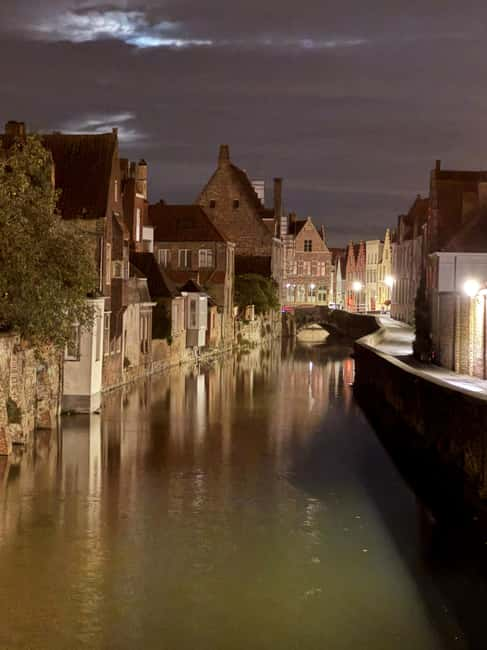
The appeal here is the contrast. By day, Bruges can feel almost too polished: canals, old brick houses, stone bridges, and postcard squares. At night, the same places become quieter and harder to read. A dark window looks occupied. A bell sounds farther away. A narrow passage seems to have more history than space.
That change in mood is the tour’s main strength. You are not simply hearing a list of ghost stories in a pub or theater. You move through the city and hear about the people who lived, suffered, prayed, betrayed, and died there.
The stories cover several centuries, but they share a common thread. Bruges’ beauty was built alongside disease, punishment, religious power, social fear, and sudden violence. The guide’s job is to connect those pieces without turning every old stone into a haunted object.
The experience is in English and lasts 90 minutes. That is long enough to cover several major sites without taking over your whole evening. It is also short enough to fit after a day of sightseeing or before dinner. Since you walk from stop to stop, comfortable shoes matter more than dressing up.
More Ghost Walking Tours in the world
- New Orleans Premier Ghost, Voodoo and Vampire Walking Tour
★ 4.5 · 12,856 reviews - Chicago: Gangsters and Ghosts Walking Tour
★ 5.0 · 7,155 reviews - Prague: Ghost Walking Tour Where Legends Come To Life
★ 4.4 · 5,253 reviews
Market Square and the bells of the Black Plague
The meeting point is Market Square, in front of the Belfort Tower. This gives the tour a strong opening because the square was not just a pretty gathering place. It was once the commercial heart of Bruges and a setting for public life, trade, punishment, and death.
Here, the guide explains how the Black Plague struck the city. Nearly half of Bruges’ population perished, and the Belfry bells were said to toll again and again as death spread through the streets.
The story of the priest who buried the victims adds a human face to the disaster. He kept serving the dead until he joined them, and local lore says he still walks below the cobblestones. Treat this as legend rather than established fact, but it shows how a real catastrophe becomes part of a city’s memory.
The bells are also tied to reports that they ring on their own. You are not promised a supernatural event, and the tour does not pretend to prove one. Instead, the guide gives you the old story and lets the setting do some of the work.
This opening stop also gives you useful historical context. Bruges was not simply a wealthy medieval trading center. Its prosperity existed alongside disease and fear, and the same public spaces that hosted commerce could become scenes of mass suffering.
Spanjaardstraat and the Ghost House
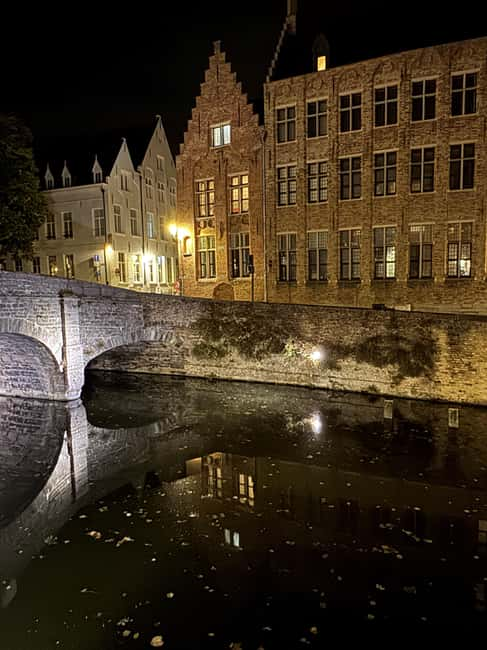
From Market Square, the route slips into a quieter alley toward the Ghost House of Spanjaardstraat. The change from a large public square to a narrow passage is important. The story feels more private here, and the surroundings make room for secrets rather than crowds.
The central tale concerns a young nun and a monk who began a forbidden romance. Their relationship ended in violence beneath the canal. The story is linked to reports of cold drafts and soft footsteps, with Sister Beatrix said to remain on her nightly route.
This is the sort of stop that works best if you enjoy stories with several layers. There is the religious rule that the couple broke, the emotional force of a relationship that could not be public, and the ghost story that grew around the tragedy. The guide can connect those ideas without needing any stage machinery.
You should also keep your expectations sensible. A cold draft is not proof of a ghost, and the tour does not promise that you will hear footsteps. The value is in standing near the place tied to the tale and hearing how Bruges’ older residents made sense of strange sounds, grief, and unexplained events.
The narrow streets can be uneven and dim, so watch your footing. This is one reason the tour is not suited to people with mobility impairments.
Burg Square and the murder of Count Charles the Good
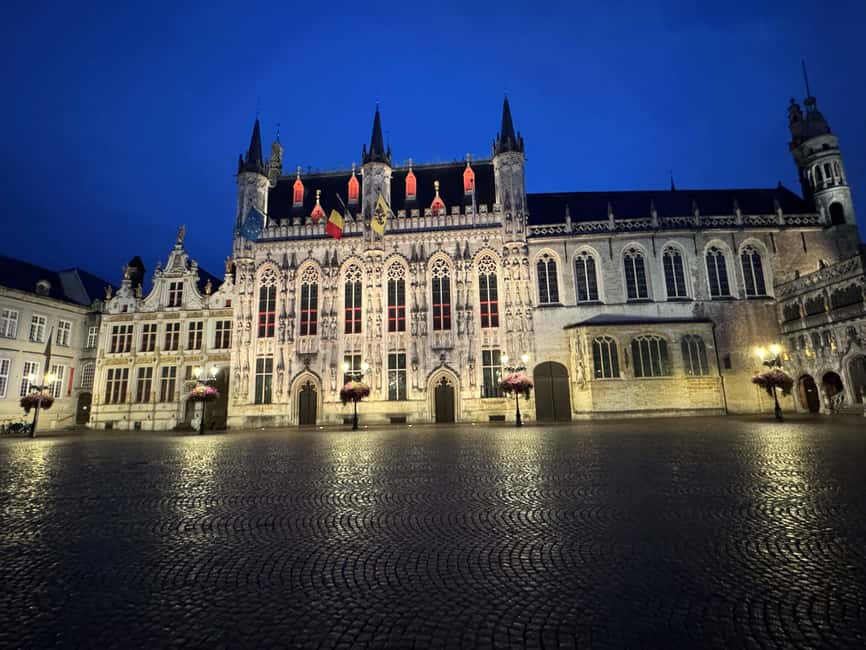
Burg Square offers a more firmly historical story. In 1127, Count Charles the Good was assassinated, and the killing shook the city. The conspirators were executed nearby in brutal fashion.
The story brings medieval politics into the tour. Bruges was not only a place of merchants and churches. It was also a city where power could be contested in public, and where punishment was meant to be seen and remembered.
The square once contained a great cathedral, adding another layer to the setting. Today, the open space can feel formal and calm. Knowing that it was tied to political murder and public executions changes how you read it.
A shadowy figure kneeling in prayer has reportedly been seen here after the square empties. Again, the guide presents this as a haunting connected to the location, not as a fact that can be tested during the walk.
I like this stop because it balances the more romantic ghost stories. The tale of a murdered ruler is not just spooky. It shows how medieval justice, religion, and political power worked together, often with grim results.
More ghost tours in the world
- The World Famous Underground Ghost Tour
★ 4.5 · 9,272 reviews - Edinburgh: Haunted Underground Vaults and Graveyard Tour
★ 4.6 · 6,607 reviews - Adults-Only New Orleans Ghost, Crime, Voodoo, and Vampire Tour
★ 5.0 · 6,545 reviews - Prague: Ghosts, Legends, Medieval Underground & Dungeon Tour
★ 4.3 · 5,104 reviews
Vismarkt and the city’s drowned secrets
The old Fish Market, or Vismarkt, brings the tour back to ordinary life. Markets were places of work and food, but also hunger, desperation, argument, and poverty. The guide uses the setting to tell stories of betrayal and people lost to the water.
Beneath the stones are said to be vaults tied to restless spirits. The exact details of the underground spaces are part of the tour’s darker storytelling, so listen for the difference between documented places and local legend.
The Vismarkt is a good reminder that a ghost story does not need a castle or cemetery. A working market can hold just as much fear. People passed through these streets every day, often dealing with danger that had nothing supernatural about it.
This stop may appeal to you if you enjoy the social side of history. The tour is not only about famous nobles, priests, or ghosts. It also points toward people who faced hunger, punishment, disease, and desperation with little control over their lives.
St. John’s Hospital and medieval suffering
The route follows the canal to St. John’s Hospital, an 800-year-old institution associated with the sick, the dying, and people praying for mercy. It is one of the tour’s strongest historical locations because the building’s original purpose already carries emotional weight.
The guide connects the hospital to plague victims and to reports of ghostly figures and unexplained sounds around the old wards. The setting makes the stories easy to picture: patients, caretakers, religious workers, and families facing illness in a period with few effective treatments.
This part of the walk also helps explain why medieval ghost stories often feel different from modern horror. They grow from real fears: infection, sudden death, religious uncertainty, and the possibility that the dead were not properly mourned.
You may find this section more somber than frightening. That is a positive if you prefer historical atmosphere to jump scares, but it may not suit you if you want a light evening activity. The material includes plague and death, and the tour is not recommended for people with heart problems.
Bonifacius Bridge and the eel below
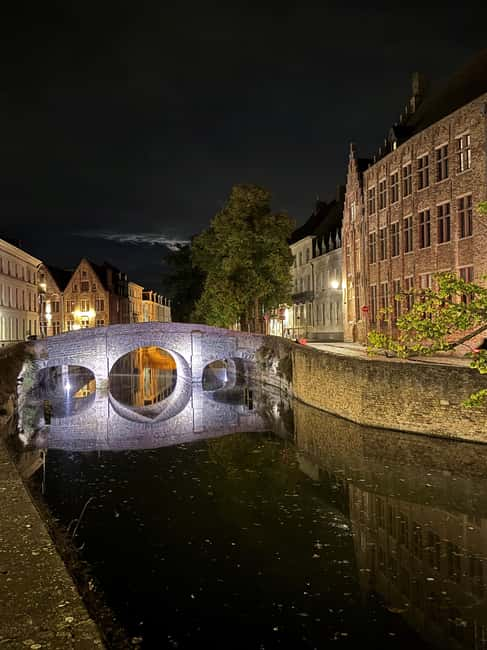
Bonifacius Bridge is one of Bruges’ most photographed spots. It is also where the tour turns a picture-perfect view into a place of danger and heartbreak.
The local legend speaks of a sinister eel that pulls unwary people into the canal. The bridge is also tied to stories of lovers who leapt into the water rather than face life apart. These tales give the romantic scenery a painful underside.
You will likely recognize why this stop works so well on a night walk. Bridges naturally invite stories about crossings, choices, departures, and people who never returned. The canal reflects the buildings, but the water also suggests depth and risk.
The story of the lovers should be treated with care. It concerns suicide, so it may be upsetting for some people. The tour’s overall subject matter makes it better suited to adults and older teenagers than to young children.
Gruuthuse Palace and the waiting woman
The final major stop is Gruuthuse Palace, once the home of a powerful medieval family. Its grandeur makes a fitting end to the route, but the tale here is not mainly about wealth. It is about loss, waiting, and the idea that status cannot protect a family from tragedy.
You hear about a woman who waited each night for a lover who never returned. The story explains why the palace windows seem to watch the street below and why the building remains linked to curses and hauntings.
That image gives the tour a quieter ending. The earlier stops involve plague, murder, punishment, and danger. Here, the fear comes from grief that refuses to leave. It is less a shock than a lingering mood.
The palace also reinforces one of the tour’s larger ideas: Bruges’ famous families lived in beautiful surroundings, but beauty did not make them safe. Behind grand walls were private losses and public pressures that could last for generations.
What Matteo’s guiding style adds
The guide is Matteo, also referred to as Mattéo in the feedback from French-speaking participants. His style is described as warm, funny, and full of local anecdotes. That matters on a tour with heavy topics.
A guide who only piles on grim details can make the experience feel flat. Matteo’s humor appears to give the walk some breathing room, while his familiarity with Bruges helps connect the major tales to smaller city details.
The strongest praise focuses on the blend of history and fright. That is a useful clue about the tour’s character. You should expect more than a string of supernatural claims, but less than a formal history lecture. The balance includes old stories, real events, local views, and the guide’s delivery.
The experience has received a top rating from three recorded bookings, with comments highlighting the unusual mix, Matteo’s warmth, his sense of humor, and his command of Bruges. That is a small sample, so I would not treat it as proof that every group will have the same experience. Still, it points to the guide as a central part of the tour’s value.
Is $29 a fair price for 90 minutes?
At $29 per person, this is not the cheapest way to spend an evening in Bruges. You can walk many of these streets without paying anything. The question is what you want from the outing.
The price pays for a live English-speaking guide who gives structure to the city’s dark stories. Without a guide, you might see Market Square, the canals, St. John’s Hospital, Bonifacius Bridge, and Gruuthuse Palace as separate sights. On this tour, they become part of one connected account of disease, faith, power, love, and death.
I think the price is reasonable if you enjoy guided storytelling and want a focused evening activity. It is less useful if you already know Bruges well, dislike ghost legends, or prefer to explore at your own pace.
The tour includes only the walking guide and live storytelling. There is no stated admission to an attraction, meal, drink, or transportation. Keep that in mind when comparing it with longer tours that include extras.
You can reserve now and pay later, and cancellation is allowed up to 24 hours before the tour for a full refund. Those terms make it easier to fit the walk into a changing Bruges schedule.
Who should book this Bruges ghost walk?
I would choose this tour if you want to see Bruges after dark and enjoy stories that sit between documented history and local legend. It suits couples, friends, solo visitors, and older families who can handle serious themes.
It is especially useful for a first visit because the route links several important central sites. You get a different way to read places you may already have seen in daylight.
I would skip it if you want a theatrical horror attraction, actors, props, or guaranteed scares. I would also skip it for children under 12, anyone with heart problems, and anyone with mobility impairments.
Wear comfortable shoes and warm clothing. The tour stays outdoors, and canal-side streets can feel chilly. Bring a willingness to listen rather than an expectation of paranormal proof.
Should you book the Haunted Bruges Walking Tour?
Book it if you want a compact, atmospheric look at Bruges’ darker past, especially if the mix of plague history, medieval punishment, doomed romance, and ghost lore sounds appealing. Matteo’s warm and humorous approach seems well suited to the material.
The best reason to go is not the promise of seeing a ghost. It is the chance to walk through familiar Bruges sights with a different set of questions. Who suffered here? Who was punished? What stories survived, and why?
For $29 and 90 minutes, this is a focused choice for an evening in the old city. Just keep your expectations clear: it is a storyteller-led historical ghost walk, not a staged scare show.
FAQ
Where does the Haunted Bruges Walking Tour meet?
The tour meets in Market Square, in front of the Belfort Tower.
How long does the tour last?
The walking tour lasts 90 minutes.
What language is the tour in?
The live tour guide speaks English.
What sites are included along the route?
The route includes Market Square, the Ghost House of Spanjaardstraat, Burg Square, Vismarkt, St. John’s Hospital, Bonifacius Bridge, and Gruuthuse Palace.
Who guides the tour?
The guide is Matteo, also written as Mattéo in some participant feedback.
Is the tour suitable for children?
No. The tour is not suitable for children under 12 because it includes stories of hauntings, historical tragedies, torture, executions, plague, and other dark subjects.
Is the tour suitable for people with mobility impairments?
No. The activity is a walking tour and is not suitable for people with mobility impairments.
What should I bring?
Bring comfortable shoes and warm clothing.
Can I cancel for a refund?
Yes. You can cancel up to 24 hours in advance for a full refund.
Can I reserve the tour and pay later?
Yes. You can reserve your place and pay later, so you do not need to pay at the time of booking.
Just added in the world
- Zion: Harry Potter-Inspired Zion Ghost Tour with Sunset View★ 5.0 · 8 reviews
- Your evening in Venice – Legends&Ghosts&Aperitif★ 4.7 · 79 reviews
- York : Private Ghost Hunt★ 5.0 · 3 reviews
- York’s Haunted Heart : Ghost, Ghouls and Gallows★ 4.6 · 82 reviews
- Wraiths of the West Texas Wind: El Paso Ghost Tour★ 4.5 · 9 reviews
- Witches, ghosts and executioners / Mystical North Hesse★ 4.4 · 4 reviews
- Wraiths & Wicked Whispers: Wilmington Ghost Tour★ 4.2 · 25 reviews
- Witches, Widows, & Wraiths: Wichita Ghost Tours★ 5.0 · 2 reviews
Ghost Walking Tours, compared.
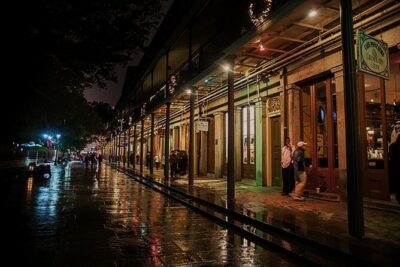
New Orleans Premier Ghost, Voodoo and Vampire Walking Tour
Read our review →
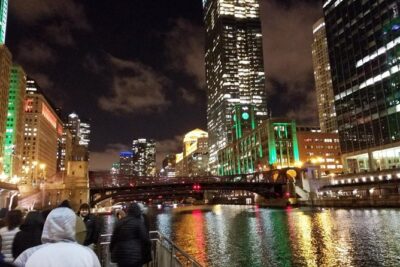
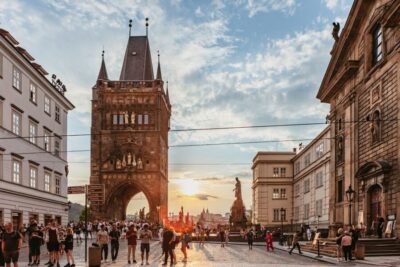
Ghost Walking Tour Where Legends Come To Life
Read our review →
Savannah History and Haunts Candlelit Ghost Walking Tour
Read our review →
Ghosts of Charleston Night-Time Walking Tour with Unitarian Church Graveyard
Read our review →