
Review · TORONTO
Toronto Old Town: Self-Guided Dark History Walking Game
Toronto’s Old Town becomes a self-guided mystery walk on this app-based game, with 10 puzzles leading from Toronto City Hall to St. Lawrence Market. Instead of following a guide, you look closely at each landmark, solve a clue, and receive the next stop and a short piece of local history.
I like the freedom to pause for a coffee, lunch, or photos, then continue when you are ready. I also like the low price, $8.44 per person, which makes this a sensible choice for a private group that wants a little structure without paying for a full guided tour.
The tradeoff is simple: there is no physical guide to add context, answer questions, or keep the group moving. You need a charged phone, the Questo app, and enough patience to study your surroundings rather than simply follow a storyteller.
Key points at a glance
- Ten historic stops: Follow a route from Toronto City Hall through Old Town to St. Lawrence Market.
- Puzzle-led sightseeing: Each location includes a challenge that reveals the next destination.
- Private and flexible: Only your group participates, and you can pause or resume at any time.
- Strong value at $8.44: The price is modest for a 90-minute activity shared with friends or family.
- Download before starting: After the initial download, no Wi-Fi is needed during the game.
- Dark stories in a bright city: The route pairs famous civic buildings, hotels, markets, and cultural sites with unusual or shadowy pieces of Toronto’s past.
How the Toronto Old Town game works
This is not a traditional walking tour with a guide waiting at a meeting point. You begin at Toronto City Hall, at 100 Queen Street West, open the Questo app, and follow step-by-step directions toward St. Lawrence Market.
At each stop, you search for an answer in the surroundings. The challenge may require you to notice a detail on a building, sculpture, sign, or public space. Once you enter the correct answer, the game provides the next location and more story content.
That format changes the way you look at downtown. On an ordinary walk, you might pass a grand hotel or courthouse without giving it much thought. Here, the puzzle gives you a reason to stop and inspect the place.
The advertised time is about 90 minutes. I would treat that as a target rather than a strict schedule. A group that solves clues quickly may finish sooner, while a group that pauses for photographs, food, or a closer look at the buildings will take longer.
You can play at any time during the stated operating period, from noon on May 1, 2025 through April 30, 2026, and again from May 1, 2026 through April 30, 2027. The activity is available every day, around the clock, which is useful if your Toronto plans do not fit a fixed tour departure.
More Self-Guided Ghost Tours in Canada
- Medieval Torture Museum Ticket with Audio Guide and Ghost Hunting
★ 5.0 · 962 reviews - Self-Guided Smartphone Ghost Walking Tour in Salem
★ 4.5 · 225 reviews - Glasgow Ghost Hunt: The Soul That Got Away Exploration Game
★ 4.0 · 71 reviews
Starting at Toronto City Hall and the Toronto sign
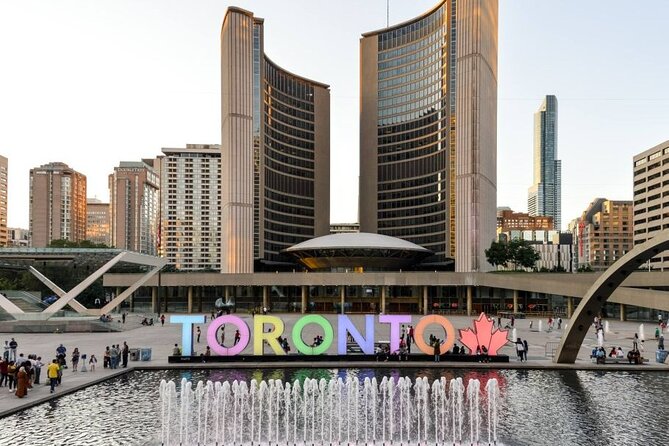
The opening section begins around Toronto City Hall, one of the city’s most recognizable civic areas. The first challenge takes you to the famous Toronto sign, which was installed for the 2015 Pan American Games.
The sign was originally meant to be temporary and scheduled for removal in November 2016 at the earliest. It became popular enough with residents and visitors that the city kept it in place. That small piece of recent urban history fits the game well: a temporary attraction became a permanent part of the city’s public image.
Here, the puzzle asks you to look around for the answer. This is a good introduction to the format because the sign is easy to recognize, but the challenge still requires attention. If you arrive during a busy period, give yourself room to inspect the area and enter the answer without feeling rushed.
Starting at City Hall also gives you a clear landmark for meeting your group. Since the activity is private, nobody outside your party is added to the game. That makes it more comfortable for families, couples, or friends who want to work out the clues together.
Old City Hall and Toronto’s civic past
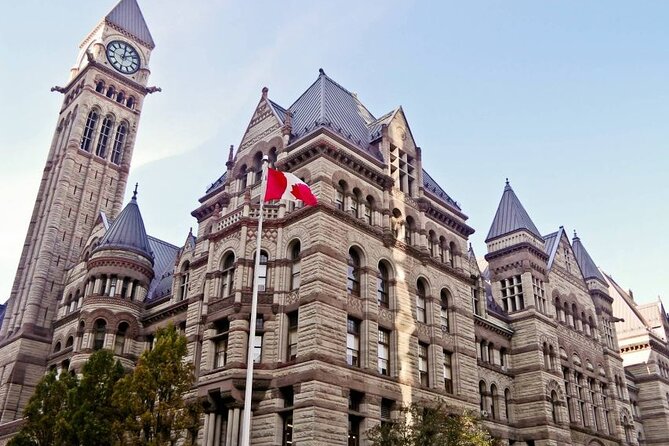
From the modern City Hall area, the game points you toward Old City Hall. Completed in 1899, it was one of Toronto’s largest buildings and the largest civic building in North America at the time.
Old City Hall was Toronto’s third city hall. It housed municipal government and courts serving both York County and Toronto, replacing the Adelaide Street Court House. Those details give the stop more weight than a quick photograph outside a grand building.
The puzzle asks you to study the site for a detail that will send you onward. I like this stop because it shows how quickly Toronto’s civic ambitions grew. The building was not designed as a modest local office. It reflected a city that wanted a major public institution to match its rising importance.
You should allow time to look beyond the challenge itself. The building’s size and decoration are part of the reward, even if your group solves the answer quickly. The game provides a reason to stop, but you still control how long you stay.
The TD Centre and Oscar Peterson Place
The route then moves into Toronto’s Financial District and the Toronto-Dominion Centre. The complex includes six towers and a pavilion, marked by bronze-tinted glass and black-painted steel.
The TD Centre serves as the global headquarters of Toronto-Dominion Bank and includes offices and retail space for many other companies. About 21,000 people work there, making it Canada’s largest commercial office complex.
This is a useful change of mood. The earlier stops focus on civic buildings and public history. Here, you see the scale of modern corporate Toronto. The game turns that office district into a place to investigate rather than simply cross on the way to somewhere else.
Between the towers, the route reaches Oscar Peterson Place. The northern section contains a more formal granite area, while the southern section includes a lawn and The Pasture, a sculpture by Saskatchewan artist Joe Fafard, who died in early 2019.
The puzzle may encourage you to examine details that would otherwise blur into the city’s daily rush. If you enjoy public art, this is one of the more rewarding stops. If your group wants only old buildings, the office complex may feel less atmospheric, but it gives the walk a useful contrast.
More Dark History Tours in Canada
- Toronto: Dark History Nighttime Walking Tour
★ 4.7 · 273 reviews - Adults-Only New Orleans Ghost, Crime, Voodoo, and Vampire Tour
★ 5.0 · 6,545 reviews - Edinburgh: Dark Secrets of the Old Town Ghost Walking Tour
★ 4.6 · 1,671 reviews - New Orleans Adults-Only True Crime and Ghost Walking Tour
★ 5.0 · 1,666 reviews
The Fairmont Royal York and Toronto’s grand-hotel era
The Fairmont Royal York brings the route back to a major landmark with a long connection to Toronto’s public life. For nearly 90 years, the hotel has hosted royal guests, heads of state, celebrities, sports stars, and millions of other visitors.
The building represents Toronto’s luxury-hotel tradition and its role as a place where important people stayed, met, and passed through. The game uses the hotel as another clue site, so you will need to look around rather than simply admire the entrance.
This stop works especially well for first-time visitors because the Royal York is one of the city’s best-known addresses. You do not need a separate hotel tour to appreciate its place in Toronto’s story. The app gives you a compact bit of context, then asks you to continue.
Because the route is self-guided, you can decide how much time to spend on the surroundings. Keep the group together while entering the answer, especially if the area is crowded. The game does not include a guide to gather anyone who wanders ahead.
The Hockey Hall of Fame and Canada’s favorite sport
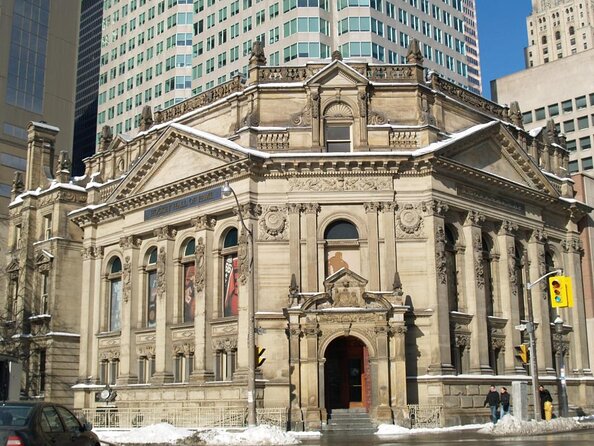
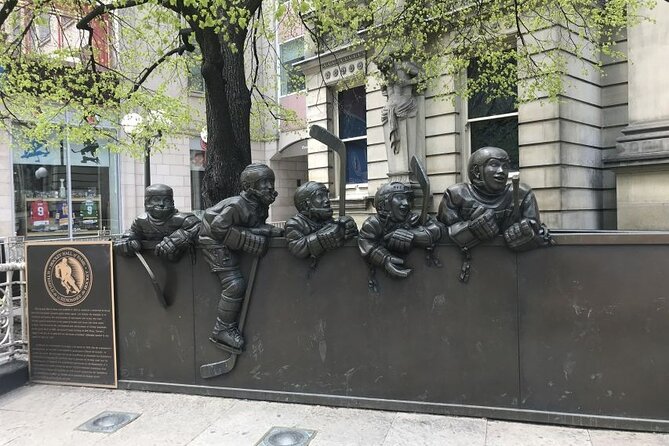
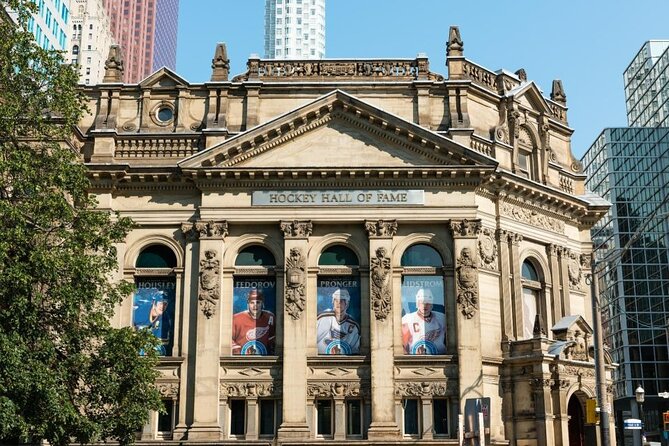
The next stop is the Hockey Hall of Fame, now located in Brookfield Place inside a historic Bank of Montreal building. Its first permanent building opened at Exhibition Place in 1961, and the hall moved to downtown Toronto in 1993.
Since 1998, it has hosted exhibits connected with the International Ice Hockey Federation, along with the IIHF Hall of Fame. Even if you are not planning to enter, the building and institution add a distinctly Canadian note to the walk.
This is a good stop for mixed groups. Hockey fans will recognize the name immediately, while people less interested in the sport still get a piece of Toronto’s civic and cultural identity. The puzzle keeps the stop brief and active rather than turning it into a museum visit.
Do not assume that the game includes admission to the Hockey Hall of Fame. The stated inclusions cover mobile access, puzzles, and story content, not entry tickets. If you want to visit inside, treat that as a separate plan and allow extra time.
The King Edward Hotel and an old claim of safety
The King Edward Hotel was designed by Chicago architect Henry Ives Cobb and Toronto architect E.J. Lennox for developer George Gooderham’s Toronto Hotel Company. It was named for King Edward VII and opened in 1903 with 400 rooms and 300 baths.
The hotel claimed to be entirely fireproof, a detail that fits the darker tone of the game. You are not simply hearing about a place where wealthy people slept. You are also getting a glimpse of the concerns and promises that shaped grand hotels in the early twentieth century.
The challenge here asks you to search for the answer at or near the landmark. This is where the game’s method is clearest: the building supplies the setting, and your group supplies the attention.
If you prefer guided storytelling, you may find the information fairly brief. If you like solving things and moving at your own speed, the short format keeps the walk from becoming a lecture.
St. James Cathedral and Toronto’s oldest congregation
The Cathedral Church of St. James introduces a religious landmark with one of the city’s earliest congregations. The parish was established in 1797, making it an important part of Toronto’s beginnings.
The cathedral is an Anglican church in downtown Toronto. Its age gives the route a different kind of historical focus, shifting from hotels, banks, office towers, and sports institutions to a long-running place of worship.
As with the other stops, you will look for a detail to answer the challenge. The game does not list a formal interior visit, so you should not expect a scheduled entry or a guide explaining the cathedral’s architecture. The value here is the chance to place the church within the wider story of the city.
This stop may appeal most to people who enjoy seeing how different institutions shaped Toronto. The route is not limited to one subject. It connects government, commerce, hotels, sport, religion, and public markets.
St. Lawrence Hall and the city’s public life
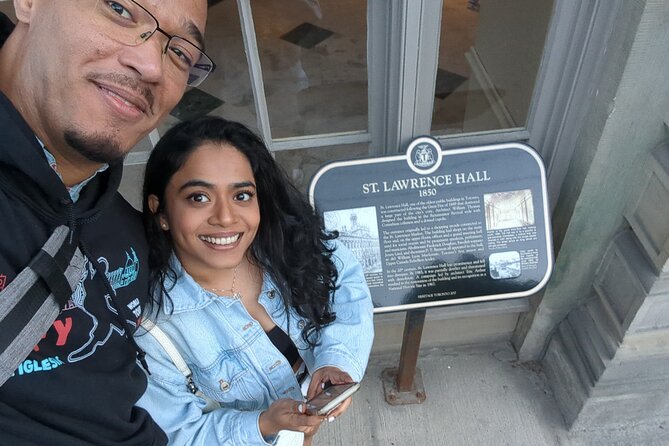
St. Lawrence Hall opened in 1850 as Toronto’s first large meeting hall. Named for Canada’s patron saint, it became a center of cultural and political life for many years.
Balls, receptions, concerts, exhibitions, and lectures took place here. That list helps you picture the building as more than an old facade. It was a place where people gathered for entertainment, debate, and public events.
The puzzle gives you a practical reason to examine the hall, while the story explains why it mattered. I find that combination more useful than a list of dates alone. You get the basic setting, then a small task that makes you pause.
This is also one of the final stops, so it helps set up the transition toward St. Lawrence Market. The route is moving from the city’s formal meeting spaces toward a public market still associated with everyday life.
Finishing at St. Lawrence Market
The final destination is the St. Lawrence Market South building at the southwest corner of Front and Lower Jarvis Streets. It forms part of the St. Lawrence Market complex along with the North Market and St. Lawrence Hall.
Ending here makes practical sense. The market is a natural place to stop after the game, and you can decide for yourself whether to continue exploring the area, find food, or simply head onward.
The activity ends at St. Lawrence Market rather than returning you to City Hall. That matters when planning your day. If you have a car, a timed reservation, or another activity near the starting point, remember that this is a point-to-point walk.
The final puzzle also gives the route a clear finish. You are not left wondering if you have missed a stop or reached the wrong square. The app guides you step by step, provided you follow its directions closely.
Price, timing, and practical value
At $8.44 per person, this is priced below most guided city walks. The value depends on what you want. You are paying for a structured route, 10 puzzles, and story content, not for a local guide who can answer questions or change the route to suit your interests.
For a family or group of friends, the price is especially reasonable. A group discount is available, and only your own party participates. That combination can make the game less expensive than booking several places on a small-group tour.
The mobile format also keeps the cost down. You receive a mobile access code and use the Questo app. Download the game before setting out, since no Wi-Fi is needed after the initial download.
You should bring a charged phone and make sure everyone understands the plan. The game is offered in English. Most people can participate, and service animals are allowed. The route is near public transportation, which helps at both ends of the walk.
Free cancellation is available if you cancel at least 24 hours before the start time. Cancellations within 24 hours are not refunded, and changes made inside that window are not accepted.
Who should book this Old Town walk?
I would choose this for independent visitors who enjoy light puzzles, city sightseeing, and the freedom to stop when they want. It also suits families and friend groups looking for an activity that gives everyone a small job.
It is less suitable if you want a polished historical talk, detailed architectural commentary, or a guide who can answer follow-up questions. The story content is designed to support the game, not replace a full walking lecture.
The 4.9 rating from 15 published ratings and a 100 percent recommendation mark suggest strong satisfaction, though the sample is small. The most useful praise centers on the easy booking process, the interesting sites and anecdotes, and the ability to set your own pace or aim for a timed finish.
Should you book it?
Book this Toronto Old Town game if you want a low-cost, private way to connect several major landmarks. The route covers an appealing mix of civic buildings, a corporate complex, public art, hotels, sport, religion, and markets. You also get a clear start and finish, plus the freedom to pause.
Skip it if you want a human guide or if puzzle solving sounds like work rather than fun. For everyone else, $8.44 buys a tidy 90-minute framework for seeing central Toronto with more purpose than a simple walk between attractions.
FAQ
How long does the Toronto Old Town game take?
The activity takes approximately 1 hour and 30 minutes. You can pause and resume at any time, so your total outing may be longer if you stop for food, photographs, or other sightseeing.
Where does the game start and finish?
It starts at Toronto City Hall, 100 Queen Street West, and finishes at St. Lawrence Market in Toronto. The Questo app guides you step by step between the locations.
How many puzzles are included?
The game includes 10 puzzle challenges. You solve a challenge at each location to receive the next destination and related story content.
Is a physical tour guide included?
No. This is a self-guided activity using the Questo app. A mobile access code and the game content are included, but there is no physical tour guide.
Do I need Wi-Fi during the walk?
You need to download the game first. After the initial download, Wi-Fi is not needed while you complete the activity.
Is the activity private?
Yes. This is a private activity, so only your group participates. Group discounts are available.
Can I cancel for a full refund?
Yes, if you cancel at least 24 hours before the scheduled start time. Cancellations or changes made less than 24 hours before the start time are not accepted, and the amount paid is not refunded.
More history tours in Canada
- Haunted Walk at Beechwood Cemetery National Historic Site
★ 4.5 · 6 reviews - Savannah History and Haunts Candlelit Ghost Walking Tour
★ 5.0 · 3,235 reviews - Stockholm: Ghost Walk and Historical Tour
★ 4.7 · 2,685 reviews - New Orleans Small-Group Haunted History Carriage Tour
★ 4.5 · 2,289 reviews
Just added in Canada
- Ghost Tour of Toronto Original Haunted Walk★ 4.5 · 185 reviews
- Spirits of the Distillery District Ghost Tour★ 4.5 · 56 reviews
- Haunted Walk at Beechwood Cemetery National Historic Site★ 4.5 · 6 reviews
- Ghosts of the Bytown Museum★ 4.4 · 9 reviews
- Haunted Montreal Pub Crawl★ 4.5 · 108 reviews
- Haunted Old Montreal★ 4.5 · 71 reviews
- Original Haunted Walk of Ottawa★ 4.5 · 284 reviews
- Toronto: Dark History Nighttime Walking Tour★ 4.7 · 273 reviews
Self-Guided Ghost Hunts, compared.
Medieval Torture Museum Ticket with Audio Guide and Ghost Hunting
Read our review →
Self-Guided Smartphone Ghost Walking Tour in Salem
Read our review →
Glasgow Ghost Hunt: The Soul That Got Away Exploration Game
Read our review →
Birmingham Ghost Hunt: Haunted Self-Guide Tour & Quest
Read our review →
Manchester Haunt Quest: Solve the Mystery of the Pusher
Read our review →
Ghosts of Savannah Self-Guided Haunted Audio Tour App/EMF Reader
Read our review →
Ghosts of Munich: The Haunted Apprentice Exploration Game
Read our review →Browse the lists this tour appears in