
Review · BUCHAREST-ILFOV
Bucharest: 3-Hour Dark History Tour with a Local
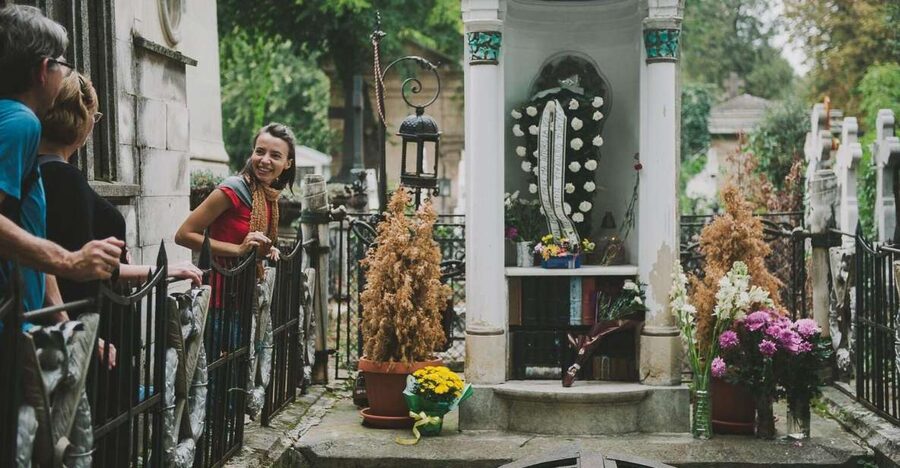
Bellu Cemetery is the heart of this three-hour walk, a quiet outdoor gallery of ornate tombs, sad love stories, folklore, and sinister tales. From there, the route connects Bucharest’s past to the bloodshed of the 1989 Revolution, the protests of the 1990s, and the fear created by communist rule. I especially like the small details, such as bullet holes, street art, local plants, and the stray cats and dogs around the cemetery.
I also like the human touch. Guides including Alex, Elena, Andra, Vlad, and Irina explain difficult subjects in a relaxed way, adding personal memories, food suggestions, and local insight. The drawback is simple: this is a walking tour, with outdoor stops and two metro rides, so bring comfortable shoes and warm clothing in cold weather.
Key points to know before booking
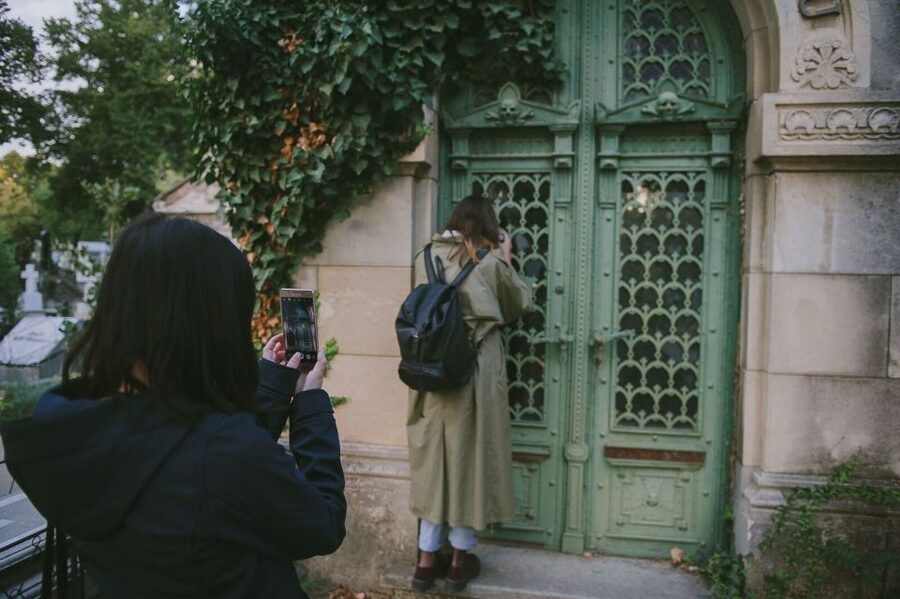
- Bellu Cemetery is the tour’s most memorable stop, with elaborate monuments and stories tied to Romanian culture and folklore.
- The route covers six cemeteries on one street, including sites connected with the 1989 Revolution, Jewish history, and Russian soldiers.
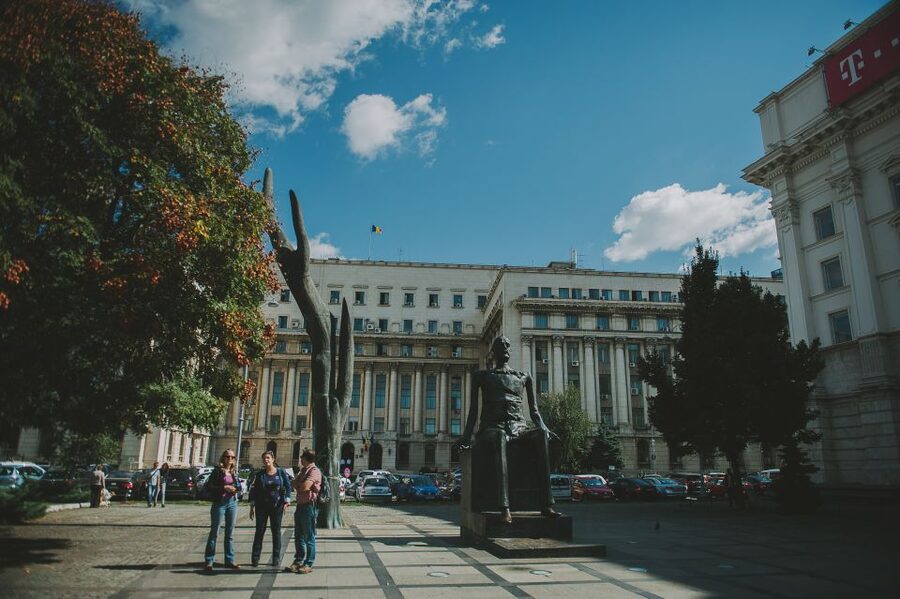
- University Square and Revolution Square give context to communist Romania, the Securitate, prisons, labour camps, and the fall of Ceaușescu.
- The tour adds unusual stories, including interwar prostitution and the serial killer known as the Vampire of Bucharest.
- Guides tailor the conversation well, with Alex, Elena, Andra, Vlad, and Irina all praised for storytelling, humour, and local insight.
- The practical package is solid, with metro tickets, an English-speaking guide, and a traditional street snack included in the $55 price.
Why Bucharest’s darker side works best on foot
Bucharest can be hard to read at first. Grand avenues, worn apartment blocks, ornate old buildings, memorials, and communist-era structures often sit close together without an obvious explanation. This tour gives those places a connecting thread.
You begin at the main entrance of the Ion Luca Caragiale National Theatre on Bulevardul Nicolae Bălcescu 2. That central meeting point is easy to find, and the route then uses public transport and walking to reach places that do not usually appear on a standard city introduction.
The subject matter is serious, but the tone is not grim from start to finish. The guides use humour, folklore, architecture, and everyday stories to make the material easier to follow. Alex is especially praised for pointing out details that most people would miss. Elena is known for a friendly, personal approach, while Andra, Vlad, and Irina are praised for explaining difficult parts of Romanian history clearly.
The maximum group size is 12 people. That matters here. A cemetery or a memorial can become awkward with a large crowd, while a small group allows you to ask questions and hear the guide without struggling over traffic noise.
More Dark History Tours in the world
- Adults-Only New Orleans Ghost, Crime, Voodoo, and Vampire Tour
★ 5.0 · 6,545 reviews - Edinburgh: Dark Secrets of the Old Town Ghost Walking Tour
★ 4.6 · 1,671 reviews - New Orleans Adults-Only True Crime and Ghost Walking Tour
★ 5.0 · 1,666 reviews
Six cemeteries and the road to Bellu
One of the first ideas introduced on the tour is that a single street near central Bucharest accommodates six cemeteries. That concentration tells you something about how the city grew, how its communities were separated, and how war and political violence left their mark.
The sites include the Cemetery of the Victims of the Revolution in 1989, the Jewish Cemetery, the Cemetery of the Russian Soldiers, and Bellu Cemetery. You do not simply pass a row of graves and move on. The guide uses the area to explain the people and events behind the monuments.
The Cemetery of the Victims of the Revolution connects the physical setting to Romania’s break with communism. The Jewish Cemetery adds another layer, bringing attention to a community and a part of Bucharest’s past that can be missed if you stick to the major boulevards. The Russian soldiers’ cemetery points toward the wars and shifting powers that affected Romania.
The route’s cemetery focus may not suit everyone. If you prefer food markets, royal residences, or polished architectural highlights, this is a different kind of city walk. You spend time with graves, funerary art, political violence, and unsettling stories. For people interested in how a city remembers its dead, it is one of the tour’s strongest features.
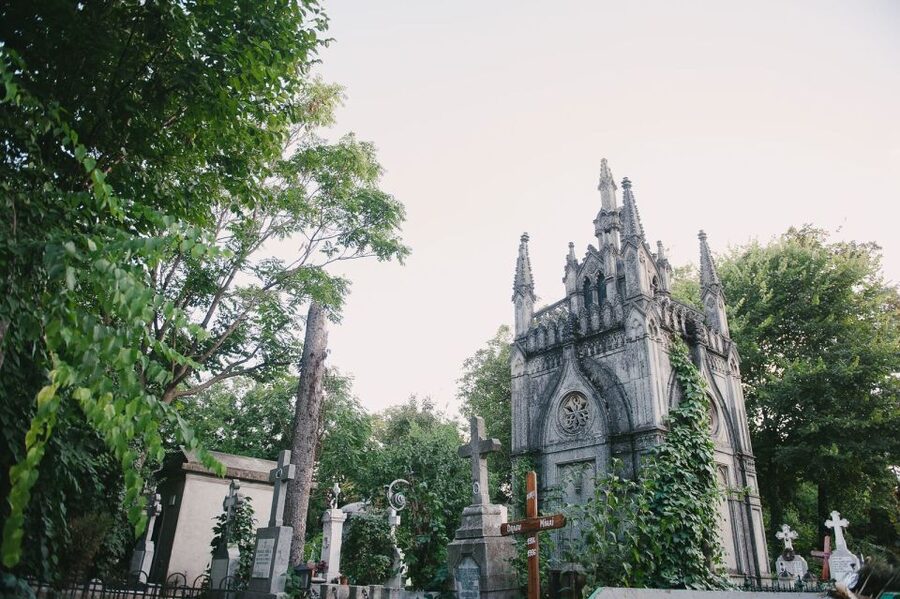
Bellu Cemetery, an outdoor gallery of stone and memory
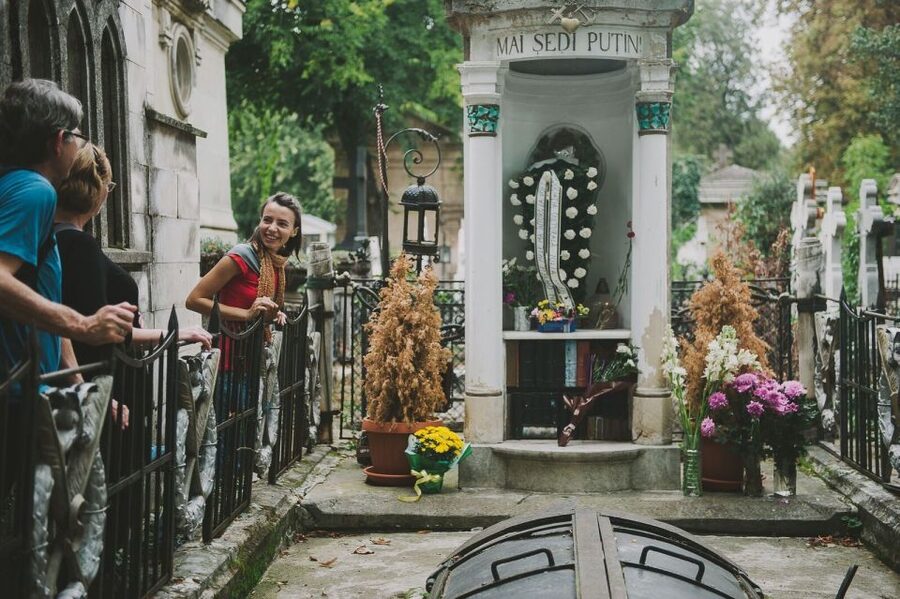
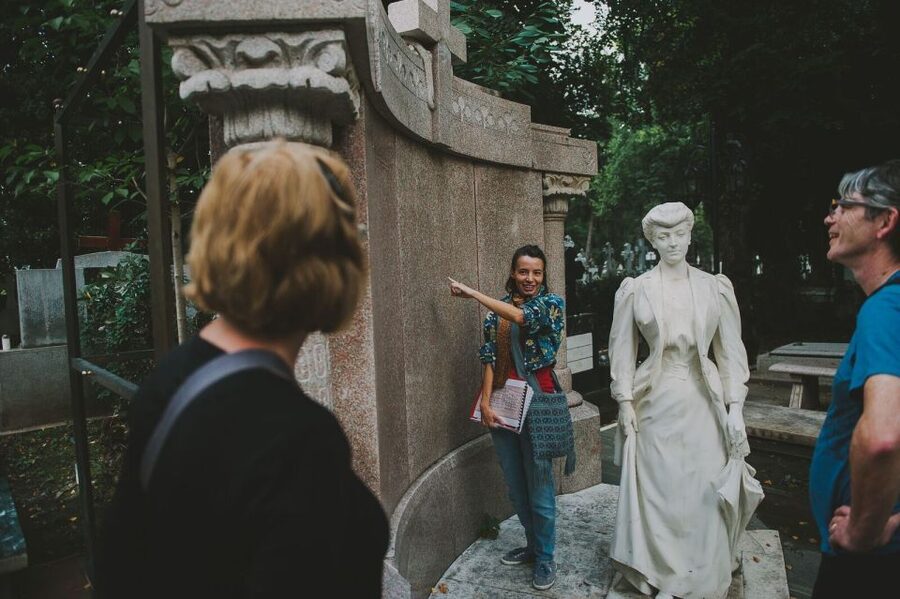
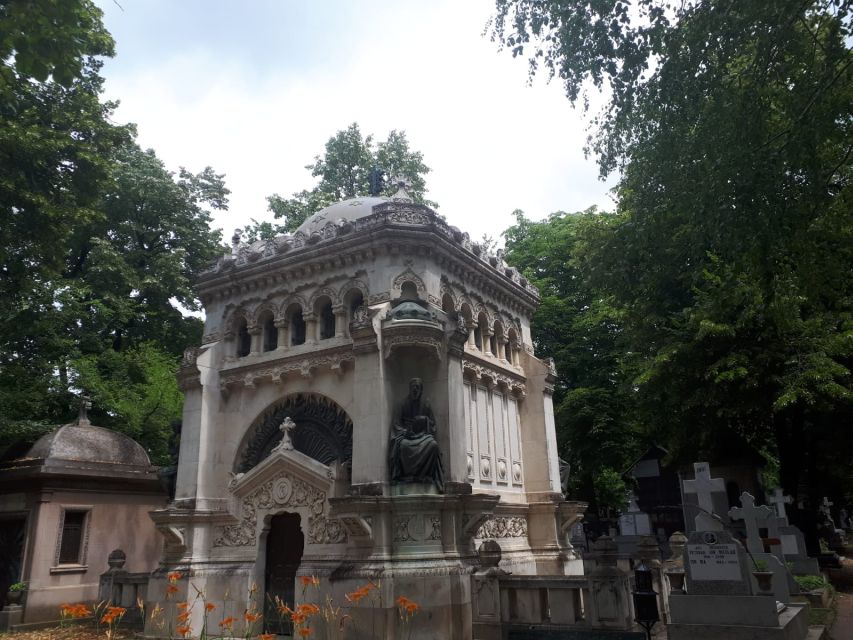
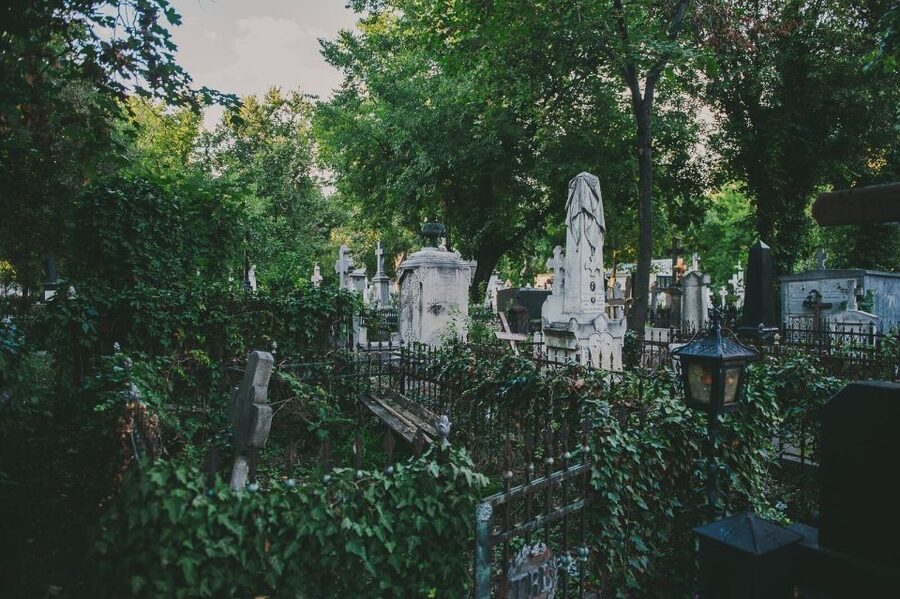
Bellu Cemetery is a national historical monument and the clear centerpiece of the experience. It has the feel of an open-air gallery, with elaborate crypts, carved figures, chapels, and memorials. The attraction is not only visual. Each monument gives the guide a way to talk about family, status, religion, romance, grief, and Romanian beliefs about death.
The stories range from tragic love to strange mysteries. This variety keeps the cemetery from feeling like a single long lecture. One moment you may be looking at the design of a tomb, and the next you are hearing about the person buried there or a local belief linked to death and mourning.
The guides’ personal styles make a real difference. Elena has been praised for her warmth toward the cemetery’s cats and dogs, and some tours include time to feed or pet the animals that live there. That is not the main purpose of the visit, but it adds a gentle, human note to an otherwise somber place.
Allow yourself to look closely. The best parts may be small carvings, worn inscriptions, unusual statues, or the way different monuments reflect changing tastes. Alex is particularly good at directing attention to such details, including local plants and features that you could easily walk past.
You should wear shoes with a firm sole. The visit involves walking through cemetery grounds, and the entire experience is more comfortable when you are ready to stay on your feet.
University Square and the blood of 1989
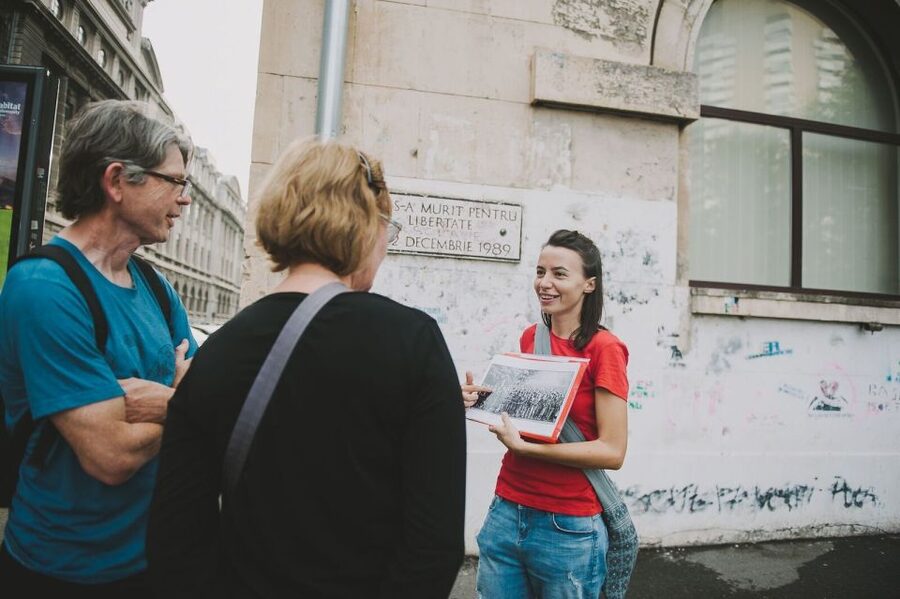
After the cemetery, the tour shifts from old graves to modern political memory. University Square is one of Bucharest’s most important public spaces and played a major role in the 1989 Revolution and the anti-communist student protests of the 1990s.
The guide explains why this location mattered and how demonstrations here became tied to violence and political conflict. This is not history presented as a clean sequence of dates. You hear about the pressure on ordinary people, the anger of students, and the costs faced by those who challenged the system.
The square is also a useful place to connect Romania’s recent past with the city you see now. A normal-looking intersection can carry memories of gunfire, protest, fear, and political change. That contrast is one reason the walking format works so well.
The discussion may feel intense, especially if your knowledge of Romanian communism is limited. Guides such as Vlad and Elena are praised for answering questions and adjusting the level of detail to the group. You can ask about daily life, political events, architecture, or the way Bucharest changed after 1989.
More history tours in the world
- Savannah History and Haunts Candlelit Ghost Walking Tour
★ 5.0 · 3,235 reviews - Stockholm: Ghost Walk and Historical Tour
★ 4.7 · 2,685 reviews - New Orleans Small-Group Haunted History Carriage Tour
★ 4.5 · 2,289 reviews - New Orleans Haunted History Ghost Tour
★ 4.5 · 2,084 reviews
Little Paris, brothels, and the Vampire of Bucharest
Bucharest was once known as Little Paris, a nickname linked to its French-influenced architecture, sophisticated social life, and cultural ambitions. The tour uses that period to show a less polished side of interwar Bucharest: the sex trade and the city’s former brothel district.
You get a glimpse of what remains of an old interwar brothel rather than a preserved museum interior. That distinction matters. This is about reading traces of the past in the modern city, not touring a fully restored attraction.
The subject is handled as social history, not just scandal. The guide discusses the place of prostitution in Bucharest and the atmosphere of the city during the interwar years. It gives you a better sense of how nightlife, class, gender, and reputation shaped urban life.
The route also includes the story of a serial killer who terrorized Bucharest in the early 1970s. He was nicknamed the Vampire of Bucharest. This is the most crime-focused part of the tour and will appeal to anyone who likes unsettling local stories, but it is not presented as a supernatural attraction. The broader point is how fear spread through the city and how the case entered local memory.
This section gives the tour variety. Without it, the experience could feel like a concentrated lesson in political repression. The interwar material adds social colour, while the murder story brings the city’s darker folklore and crime history into the picture.
Revolution Square and the machinery of communist fear
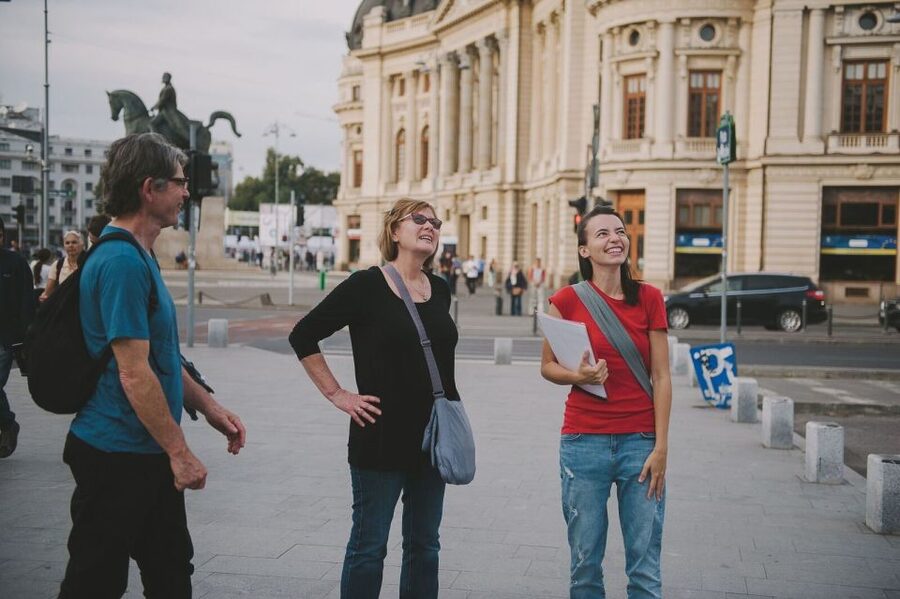
The final major stop is Revolution Square, the place where the 1989 Revolution began in Bucharest. Here, the focus turns firmly to Nicolae Ceaușescu’s dictatorship and the tools used to silence critics.
You learn about prisons, labour camps, torture methods, and the Securitate, Romania’s secret police. The guide also discusses the daily hardships people faced as they tried to survive under the communist system. This part is valuable because it moves beyond famous political figures. It asks what fear and shortage meant in ordinary life.
The Securitate is often compared with other communist secret police forces, but the tour keeps the discussion connected to Romania. You hear how surveillance and intimidation affected trust, speech, family life, and public behaviour. The subject can be difficult, yet guides such as Andra and Vlad are praised for presenting complex events in a clear, conversational way.
Look carefully around the square. Bullet holes and other small physical details may still be visible, and guides can point out features that do not announce themselves as historical markers. That attention to the ordinary appearance of important places is one of the best reasons to take this walk with someone who knows Bucharest well.
A three-hour route with plenty of walking
The tour lasts three hours and includes metro travel between parts of the route. Metro tickets are included, so you do not need to work out the local system during the experience. The two rides also help connect districts that would be too far apart for an efficient walking route.
Still, do not treat this as a gentle stroll. Several people who enjoyed the tour strongly recommend comfortable shoes, and cold-weather visitors should dress more warmly than they expect. Much of the commentary happens outdoors, and standing still in a cemetery or square can feel colder than walking through the city.
The tour provides a traditional street snack. Depending on the guide and the day, the experience can also include water or an additional small Romanian treat, but the guaranteed inclusion is the traditional snack. Food and drinks beyond that are not included, so carry money if you want to buy something else.
Guides may add extra time when the group is small or the conversation is flowing. That is a pleasant possibility, not something you should count on when planning your day. Keep a little space after the three-hour end time if you want to ask questions or accept local suggestions for restaurants and cafés.
Is $55 a fair price?
At $55 per person, this is more expensive than a basic free city walk, but it offers a narrower subject and a more involved route. You are paying for a small group, an English-speaking local guide, metro tickets, and access to stories that are not easy to assemble on your own.
The value is strongest if you want context rather than a checklist of sights. Bellu Cemetery alone can be visited independently, but understanding its monuments, folklore, and people takes research. The same is true of University Square and Revolution Square. A guide helps you see how the places connect.
The price also makes more sense if you use the tour early in your Bucharest stay. Guides often provide restaurant, café, food, and further reading suggestions. You can then use those tips for the rest of your visit.
It is less suitable if your main goal is to cover many classic landmarks quickly. The tour does not focus on a broad list of palaces, museums, or churches. It chooses a darker thread and follows it carefully.
Who should book this Bucharest dark history tour?
I would choose this experience if you enjoy political history, cemeteries, crime stories, folklore, architecture, or the personal side of recent European history. It is also a strong choice if you have already seen Bucharest’s standard central sights and want something less predictable.
You do not need to be an expert on Romania. The guides are praised for making difficult subjects understandable and for answering questions across history, architecture, culture, and daily life. Alex, Elena, Andra, Vlad, and Irina each bring a slightly different personality, so the tone may vary, but the common thread is enthusiasm and strong local knowledge.
This is not for children under 16. It is also not ideal for anyone uncomfortable with discussions of murder, torture, political violence, death, or prostitution. Even if you enjoy spooky stories, the tour treats real suffering seriously rather than turning it into a simple ghost walk.
Book it when the weather is suitable for an outdoor walk, or dress carefully if you are visiting in winter. The advice to wrap up warmly appears again and again for good reason.
Should you book it?
Book this tour if you want Bucharest explained through its cemeteries, dictators, victims, protesters, criminals, and survivors. The best parts are Bellu Cemetery, the close look at Revolution Square, and the guides’ habit of pointing out details you would probably miss alone.
Skip it if you want a short, indoor activity or a standard introduction to famous landmarks. For everyone else, the $55 price is reasonable for a three-hour, small-group experience with transport included and a local guide who can turn unsettling places into a clear, memorable story of Bucharest.
FAQ
How long does the Bucharest Dark History Tour last?
The tour lasts three hours.
Where does the tour meet?
The meeting point is at the main entrance of the Ion Luca Caragiale National Theatre, Bulevardul Nicolae Bălcescu 2, Bucharest.
What language is the tour conducted in?
The tour is conducted in English with a live English-speaking guide.
Is Bellu Cemetery included?
Yes. Bellu Cemetery is a central stop on the route, and the visit includes its monuments, funerary architecture, and stories.
Are metro tickets included?
Yes. Metro tickets for the rides used during the tour are included.
Is food included?
A traditional street snack is included. Additional food and drinks are not included.
Can children join the tour?
No. Participants must be at least 16 years old.
How large is the group?
The maximum group size is 12 people.
What should I bring?
Bring comfortable shoes. Warm clothing is also a good idea in cold weather because much of the tour takes place outdoors.
Can I cancel the booking?
You can cancel up to 24 hours in advance for a full refund. The activity also offers reserve now and pay later booking.
More three-hour walks in the world
- 3 Hour Savannah Theatre Paranormal Investigation
★ 5.0 · 31 reviews
Just added in the world
- Dreaded Dead Descent of the District: DC Ghost Tour★ 4.2 · 186 reviews
- Hoi An Ghosts, Death, Mystery Unveiled★ 5.0 · 33 reviews
- Ho Chi Minh City: Ghost, Belief & Culture Tour on Motorbike★ 5.0 · 5 reviews
- HCM city Chinatown Landscape, Beliefs & ghost tour by scooter★ 5.0 · 22 reviews
- Hoi An Ghosts, Death, Mystery Unveiled★ 5.0 · 25 reviews
- Spooky Vienna Ghost Tour in English★ 4.5 · 49 reviews
- Phantoms of the Potomac: Old Town Alexandria Ghost Tour★ 4.0 · 56 reviews
- Alexandria Ghosts Spirits & Spirits Haunted Pub Crawl★ 5.0 · 26 reviews
Dark History & True Crime Tours, compared.
Adults-Only New Orleans Ghost, Crime, Voodoo, and Vampire Tour
Read our review →
Dark Secrets of the Old Town Ghost Walking Tour
Read our review →
New Orleans Adults-Only True Crime and Ghost Walking Tour
Read our review →
Genteel and Bard’s Savannah Dark History and Ghost Encounter Walking Tour
Read our review →
Buda Castle District Dark History, Legends and Vampire Night Tour
Read our review →
Edinburgh Ghost Tour: Mysteries, Legends and Murders
Read our review →Browse the lists this tour appears in